Basics, lights & sound signals
Who is the skipper, when is a vessel under way, how long is a short blast? These are the basics both licences build on, plus the first questions on lights and giving way.
Question 1 · Basic question
What must be done if it has not been established who the skipper is before departure?
- A The responsible skipper must be appointed. Correct
- B The responsible skipper must be elected.
- C A holder of a pleasure craft licence must take command of the vessel.
- D A holder of a pleasure craft licence must assume responsibility.
Explanation by Boatpass
If it has not been established who is the vessel's master, the responsible master must be appointed before departure.
Question 2 · Basic question
In which cases may a pleasure craft neither be operated nor its course or speed independently determined?
- A When one is impaired in the safe operation of the vessel due to physical or mental deficiencies or due to the consumption of alcoholic beverages or other intoxicants, or when a blood alcohol concentration of 0.5 ‰ or more is present in the body. Correct
- B When one is impaired in the safe operation of the vessel due to physical or mental deficiencies or due to the consumption of alcoholic beverages or other intoxicants, or when a blood alcohol concentration of 0.8 ‰ or more is present in the body.
- C When one is impaired in the safe operation of the vessel due to physical or mental deficiencies or due to the consumption of alcoholic beverages or other intoxicants, or when a blood alcohol concentration of 1.0 ‰ or more is present in the body.
- D When one is impaired in the safe operation of the vessel due to physical or mental deficiencies or due to the consumption of alcoholic beverages or other intoxicants, or when a blood alcohol concentration of 0.3 ‰ or more is present in the body.
Explanation by Boatpass
A person whose ability to navigate safely is impaired by physical or mental deficiencies, alcohol or other intoxicants must neither operate the vessel nor independently determine her course or speed.
Question 3 · Basic question
When is a vessel considered underway?
- A When it is neither at anchor, nor made fast to the shore, nor aground. Correct
- B When it is neither at anchor, nor made fast to the shore, nor making way over the ground.
- C When it is neither aground, nor at anchor, nor restricted in its ability to manoeuvre, nor unable to manoeuvre.
- D When it is neither made fast to the shore, nor at anchor, nor making way through the water.
Explanation by Boatpass
A vessel is legally considered 'underway' as soon as it is neither at anchor, nor made fast to the shore, nor aground.
Question 4 · Basic question
How long is the duration of a short blast (•)?
- A About 1 second. Correct
- B About 2 seconds.
- C Less than 1 second.
- D Less than 4 seconds.
Explanation by Boatpass
A short blast lasts about one second. A prolonged blast lasts four to six seconds.
Question 5 · Basic question
How long is the duration of a prolonged blast (–)?
- A About 4 – 6 seconds. Correct
- B About 2 – 6 seconds.
- C About 1 – 2 seconds.
- D About 6 – 8 seconds.
Explanation by Boatpass
Under the COLREGs a prolonged blast lasts four to six seconds; the German Inland Waterways Regulations (BinSchStrO) say about four seconds.
Question 6 · Basic question
When is a vessel under sail considered a power-driven vessel?
- A When it is simultaneously propelled by machinery. Correct
- B When it is equipped with a propulsion engine.
- C When it makes no way through the water under sail.
- D When it makes no way over the ground under sail.
Explanation by Boatpass
A vessel under sail is treated as a power-driven vessel as soon as her machinery is being used for propulsion.
Question 7 · Basic question
What additional day shape must a vessel under sail that is considered a power-driven vessel display?
- A A black cone, point downwards. Correct
- B A black cone, point upwards.
- C A black diamond shape.
- D Two black balls in a vertical line.
Explanation by Boatpass
A sailing vessel also being propelled by machinery must exhibit by day, where it can best be seen, a black cone apex downwards.
Question 8 · Basic question
Which side is referred to as the windward side?
- A The side facing the wind. Correct
- B The side facing away from the wind.
- C The side to the right in the direction of travel.
- D The side to the left in the direction of travel.
Explanation by Boatpass
The windward side (Luvseite) is the side of the vessel facing into the wind – the side from which the wind comes.
Question 9 · Basic question
Which side is referred to as the leeward side?
- A The side facing away from the wind. Correct
- B The side facing the wind.
- C The side to the right in the direction of travel.
- D The side to the left in the direction of travel.
Explanation by Boatpass
The leeward side is the side of the vessel facing away from the wind.
Question 10 · Basic question
When must vessels exhibit their navigation lights?
- A From sunset to sunrise and in restricted visibility. Correct
- B From sunrise to sunset and in restricted visibility.
- C From 18:00 in the evening to 06:00 in the morning and in restricted visibility.
- D In darkness, bad weather and restricted visibility.
Explanation by Boatpass
Lights must be shown from sunset to sunrise – and additionally whenever visibility is restricted (fog, rain, haze).
Question 11 · Basic question
What is the purpose of navigation lights?
- A They indicate the direction of travel and the aspect of a vessel. Correct
- B They indicate the course and speed of a vessel.
- C They indicate the direction of travel and the position of a vessel.
- D They indicate the direction of travel and the course of a vessel.
Explanation by Boatpass
Navigation lights do two jobs: they show other traffic which way a vessel is heading (direction of travel) and how she lies relative to you, i.e. which side she is showing you (aspect).
Question 12 · Basic question
What type of lantern may a sailing vessel of less than 20 m in length carry instead of sidelights and a sternlight?
- A A tri-colour lantern at or near the masthead. Correct
- B A two-colour lantern at a well-visible position.
- C A tri-colour lantern at a well-visible position.
- D A two-colour lantern at or near the masthead.
Explanation by Boatpass
Small sailing vessels under 20 metres may use a single tri-colour lantern instead of three separate lights (starboard, port, stern).
Question 13 · Basic question
What lights must a vessel under sail that is simultaneously propelled by machinery exhibit?
- A The lights prescribed for a power-driven vessel. Correct
- B The lights prescribed for a sailing vessel.
- C Two red all-round lights in a vertical line.
- D Sidelights red and green and one red all-round light.
Explanation by Boatpass
When a vessel under sail is also propelled by machinery, she must display the lights prescribed for a power-driven vessel of her size under Rule 23 of the International Regulations for …
Question 14 · Basic question
How do two power-driven vessels give way when approaching each other on opposite courses?
- A Each vessel must alter its course to starboard. Correct
- B Each vessel must alter its course to port.
- C The vessel on the windward side must give way to the vessel on the leeward side.
- D The vessel on the leeward side must give way to the vessel on the windward side.
Explanation by Boatpass
When two power-driven vessels are meeting on reciprocal or nearly reciprocal courses so as to involve risk of collision, each must alter course to starboard so that they pass port-to-port.
Question 15 · Basic question
Two power-driven vessels are approaching on crossing courses. There is a risk of collision. Which vessel must give way?
- A The vessel that has the other on its starboard side must give way. Correct
- B The vessel that has the other on its port side must give way.
- C The vessel on the windward side must give way to the vessel on the leeward side.
- D The vessel on the leeward side must give way to the vessel on the windward side.
Explanation by Boatpass
When two power-driven vessels are crossing, the vessel which has the other on her own starboard side must keep out of the way and should, if circumstances permit, avoid crossing ahead of …
Question 16 · Basic question
What is the meaning of the following sound signal (• – • – • – • – • –)?
- A Keep-clear signal – leave the danger zone immediately. Correct
- B General danger and warning signal.
- C Vessel at anchor, length over 100 m.
- D Towing vessel restricted in ability to manoeuvre, tow exceeding 200 m in length.
Explanation by Boatpass
The keep-clear signal warns that specified dangerous goods or radioactive substances are escaping or may escape, or that there is a risk of explosion.
Signboards & navigation signs
Prohibition, mandatory and information signs plus lights at bridges and locks. Almost every question has a picture: memorise shape and colour, not just the wording.
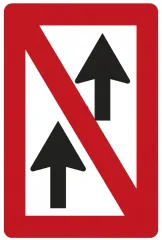
Question 17 · Basic question
What is the meaning of the following waterway sign?
- A No overtaking. Correct
- B No meeting.
- C No overtaking for vessels under 20 m in length.
- D No meeting for vessels over 20 m in length.
Explanation by Boatpass
The board with a red border and red diagonal bar shows two black arrows pointing the same way: this is the no-overtaking sign.
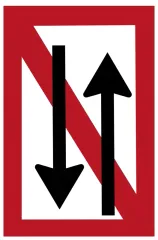
Question 18 · Basic question
What is the meaning of the following waterway sign?
- A No meeting at a narrow section. Correct
- B No meeting for vessels over 12 m in length.
- C No overtaking; oncoming traffic must be expected.
- D No overtaking for all vessels.
Explanation by Boatpass
Two black arrows pointing in opposite directions, crossed out in red: vessels must not meet from here on.
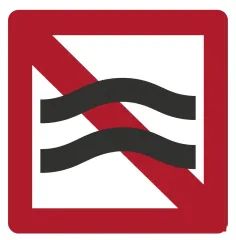
Question 19 · Basic question
What is the meaning of the following waterway sign?
- A Avoid suction and wash. Correct
- B Area of beach at risk of flooding; minimum passing distance 100 metres.
- C Waterway that can be navigated safely at all times; no danger from sea state.
- D Waterway that cannot always be navigated safely; danger from sea state.
Explanation by Boatpass
This sign calls for avoiding wash and wave action – meaning vessels must slow down so that waves and suction do not damage other boats or the bank.
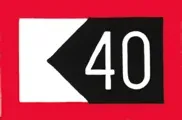
Question 20 · Basic question
What is the meaning of the following waterway sign?
- A Minimum distance in metres that must be maintained on the following section from the position of the sign. Correct
- B Maximum speed in km/h that must not be exceeded on the right-hand side of the channel in the direction of travel.
- C Maximum distance in metres that must be maintained on the following section from the position of the sign.
- D Channel narrows to 40 m.
Explanation by Boatpass
A sign displaying a number (for example '40') specifies the minimum distance in metres that a vessel must keep from the sign or the narrowed bank on the following section.
Question 21 · Basic question
What is the meaning of the following waterway sign?
- A Mandatory stop before movable bridges, barrages and locks. Correct
- B Permanent closure of a section of the waterway.
- C Mandatory sounding of one prolonged blast.
- D Passage prohibited for pleasure craft.
Explanation by Boatpass
This sign requires vessels to stop before the installation.
Question 22 · Basic question
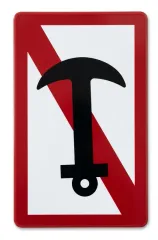
What is the meaning of the following waterway sign?
- A Anchoring prohibited for all vessels. Correct
- B Anchoring prohibited for small craft under 12 m in length.
- C Anchoring prohibited for small craft of 12 m or more in length.
- D Anchoring and mooring prohibited.
Explanation by Boatpass
The no-anchoring sign (crossed-out anchor) applies to all vessels without exception.
Question 23 · Basic question
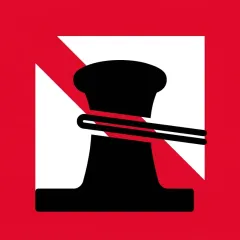
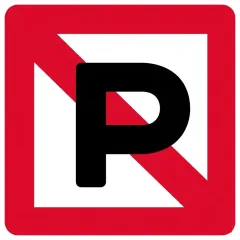
What is the meaning of the following waterway signs?
- A Mooring and berthing prohibited. Correct
- B Mooring and berthing prohibited for pleasure craft.
- C Mooring and berthing prohibited for pleasure craft over 12 m in length.
- D Mooring and berthing prohibited for commercial vessels.
Explanation by Boatpass
The sign with the crossed-out bollard prohibits mooring to the bank.
Question 24 · Basic question
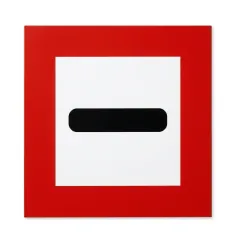
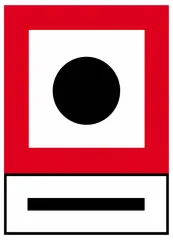
What is the meaning of the following waterway sign?
- A Sound one prolonged blast. Correct
- B Sound one short blast.
- C Sound two prolonged blasts.
- D Sound one short blast and one prolonged blast.
Explanation by Boatpass
The sign with the black dot requires you to give a sound signal.
Question 25 · Basic question
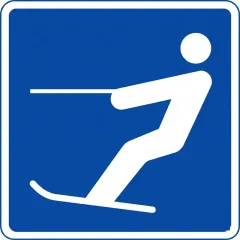
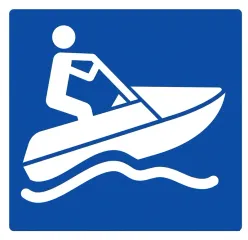
What is the meaning of the following waterway signs?
- A Water areas where water-skiing or personal watercraft are permitted. Correct
- B Training area requiring a permit for water-skiing or personal watercraft.
- C Water-skiing and personal watercraft permitted. Water-skiers and personal watercraft have right of way.
- D Permit-free training area for water-skiing or personal watercraft.
Explanation by Boatpass
These blue information signs open an area for water-skiing or for personal watercraft.
Question 26 · Basic question
What is the meaning of the following waterway sign?
- A End of a mandatory or prohibited section. Correct
- B Section for a ferry-boat not moving independently.
- C Crossing the fairway is permitted.
- D Changing sides of the fairway is permitted.
Explanation by Boatpass
The blue sign with a white diagonal stripe lifts a requirement or prohibition that applied to your direction of travel, for example a no-overtaking zone.
Question 27 · Basic question
What is the meaning of the following waterway sign?
- A Passage prohibited and navigation closed. Correct
- B Passage prohibited and closed to small craft.
- C Passage prohibited, but open to small craft without a running engine.
- D Passage prohibited, but open to small craft without a propulsion engine.
Explanation by Boatpass
The red-white-red board prohibits passage: navigation is closed here to all vessels, including small craft.
Question 28 · Basic question
What is the meaning of the following navigation signs?
- A Bridge, barrage or lock closed. Correct
- B Installation permanently closed.
- C Stop signal for all vessels.
- D Exceptional obstruction to navigation.
Explanation by Boatpass
Two red lights side by side in front of a bridge, barrage or lock mean: passage prohibited, the installation is closed.
Question 29 · Basic question
What is the meaning of the following navigation signs?
- A Installation permanently closed. Correct
- B Bridge, barrage or lock closed.
- C Stop signal for all vessels.
- D Exceptional obstruction to navigation.
Explanation by Boatpass
Two fixed red lights one above the other mean that the installation is closed to navigation.
Question 30 · Basic question
What do these lights mean in front of a lock?
- A Entry clear, oncoming traffic blocked. Correct
- B Entry clear, lock gate opening.
- C Lock in operation, wait for entry signal in order of arrival.
- D Lock in operation, wait for exit signal in order of arrival.
Explanation by Boatpass
Two green lights side by side mean: entry is cleared, but the opposite direction is blocked.
Environment, boat handling & propulsion
Consideration for nature and large ships, berthing, anchoring and how the propeller acts. The prop-walk questions belong together: once you understand where the stern swings when going astern, you get all of them right.
Question 31 · Basic question
Which leaflet contains guidance on behaviour for the protection of rare animals and plants and for keeping waterways clean?
- A The 10 Golden Rules for Water Sports Enthusiasts. Correct
- B The 15 Golden Rules for Water Sports Enthusiasts.
- C The 10 Basic Rules for Water Sports Enthusiasts.
- D The 15 Conduct Rules for Water Sports Enthusiasts.
Explanation by Boatpass
The leaflet “The 10 Golden Rules for Water Sports Enthusiasts” provides guidance on environmentally responsible behaviour on the water, including keeping away from nature reserves, avoiding …
Question 32 · Basic question
How can one help to preserve and promote the habitat of flora and fauna in waterways and wetlands?
- A By behaving in an environmentally responsible manner and observing the "Ten Golden Rules for the Behaviour of Water Sports Enthusiasts in Nature". Correct
- B By behaving in an environmentally responsible manner and observing the "Ten Basic Rules for Water Sports".
- C By acting with care and observing the traffic regulations.
- D By anticipatory navigation and giving way in accordance with the traffic regulations.
Explanation by Boatpass
Environmentally conscious behaviour protects waterways and wetlands.
Question 33 · Basic question
Why should one keep as far as possible from reed and sedge zones as well as densely vegetated bank areas?
- A Because these zones are frequently resting and breeding sites of particularly protected birds or spawning grounds for fish. Correct
- B Because there is a risk of grounding in these zones.
- C Because the vegetation could block the propeller.
- D Because swimmers are difficult to see in these zones.
Explanation by Boatpass
Reed and sedge zones are sensitive ecosystems: they serve as breeding and resting sites for rare birds and as spawning grounds for fish.
Question 34 · Basic question
Why should a small vessel not approach closely to a large vessel that is underway?
- A It may capsize due to the bow or stern wave, or be drawn into a collision by the suction. Correct
- B Approaching closely is a violation of the basic rules for conduct in traffic.
- C Because it would otherwise be unable to give way to the large vessel underway.
- D It may take water over the side from the bow or stern wave.
Explanation by Boatpass
A large vessel creates bow and stern waves as well as a powerful suction effect while underway.
Question 35 · Basic question
Why should one preferably berth against the current and wind?
- A Because the vessel can be manoeuvred more safely this way. Correct
- B Because this avoids suction and wash.
- C Because this compensates for the effects of waves and water depth.
- D Because this increases the steering effect of the propeller.
Explanation by Boatpass
Approaching against current and wind means these natural forces act as a brake.
Question 36 · Basic question
How should one behave when meeting other vessels in a narrow channel?
- A Reduce speed and maintain sufficient passing clearance. Correct
- B Increase speed in order to complete the passing manoeuvre quickly.
- C The vessel proceeding against the current must give way.
- D The vessel proceeding with the current must stop.
Explanation by Boatpass
When meeting in a narrow channel, reduce speed in good time and maintain adequate passing clearance that is safe for the local depth and traffic conditions.
Question 37 · Basic question
What dangers can arise when a small vessel is overtaken by a larger one?
- A The smaller vessel may be pushed off course by bow pressure, suction or swell, collide or broach, and run aground in shallow water. Correct
- B The larger vessel may be pushed off course by bow pressure, suction or swell, collide or broach, and run aground in shallow water.
- C The smaller vessel may be pushed off course by bow pressure, suction or swell, collide or capsize, and be severely set sideways in shallow water.
- D The larger vessel may be pushed off course by wave action, collide or broach, and run aground in shallow water.
Explanation by Boatpass
When being overtaken by a larger vessel, three forces act on the smaller boat: the bow pressure (ahead of the overtaking ship), the suction (lateral pull), and the stern wave (swell behind the ship).
Question 38 · Basic question
Where can you find information on environmentally friendly paints, varnishes and antifouling coatings for your boat?
- A At the Federal Environment Agency (Umweltbundesamt). Correct
- B At the Federal Ministry for Digital and Transport Affairs.
- C In the Pleasure Craft Licence Regulation.
- D In the Pleasure Craft Rental Regulation.
Explanation by Boatpass
The German Environment Agency (UBA) is the responsible federal authority for environmental matters.
Question 39 · Basic question
How can one tell whether the anchor is holding?
- A When no jerking is felt by placing a hand on the anchor chain or line, and the anchor bearing does not change. Correct
- B When the anchor chain or line does not vibrate and the magnetic compass heading does not change.
- C When no jerking is felt by placing a hand on the anchor chain or line, and the vessel is not swinging.
- D When no jerking is felt by placing a hand on the anchor chain or line, and the anchor bearing changes.
Explanation by Boatpass
A holding anchor is indicated when no jerking caused by the anchor skipping over the bottom can be felt in the chain or rode, and bearings of fixed shore objects show no progressive change …
Question 40 · Basic question
What is the most favourable approach angle when berthing?
- A As shallow an angle as possible. Correct
- B An angle of 90° to 100°.
- C As wide an angle as possible.
- D An angle of 60° to 70°.
Explanation by Boatpass
When berthing, the most favourable approach angle is as shallow as possible (nearly parallel to the pier).
Question 41 · Basic question
How does a vessel generally behave when going astern with a right-handed propeller?
- A The stern swings to port. Correct
- B The stern swings to starboard.
- C The vessel's course does not change.
- D The bow swings to port.
Explanation by Boatpass
On a single-screw vessel with a right-handed propeller, transverse thrust generally tends to move the stern to port when going astern.
Question 42 · Basic question
What does the kill switch (Quickstopp) do?
- A Interrupts the ignition or fuel supply. Correct
- B Automatically starts the engine.
- C Briefly interrupts engine operation.
- D Automatic thrust reversal.
Explanation by Boatpass
The kill switch (also called 'dead man's switch') is a safety device: it is attached to the helmsman by a lanyard.
Question 43 · Basic question
What must be done if fuel or oil gets into the bilge?
- A Absorb with rags and dispose of in an environmentally responsible manner. Correct
- B Ventilate the spaces and wait.
- C Spread it evenly.
- D Neutralise with a suitable agent.
Explanation by Boatpass
Absorb fuel or oil in the bilge with suitable cloths or oil-absorbent material, stop the source and dispose of the contaminated material properly ashore.
Question 44 · Basic question
What is meant by a right-handed propeller?
- A Viewed from astern, the propeller rotates clockwise when going ahead. Correct
- B Viewed from forward, the propeller rotates clockwise when going ahead.
- C Viewed from astern, the propeller rotates counter-clockwise when going ahead.
- D Viewed from forward, the propeller rotates counter-clockwise when going astern.
Explanation by Boatpass
The term 'right-handed' refers to the view from astern (from behind) towards the propeller while the vessel moves ahead.
Question 45 · Basic question
What is meant by a left-handed propeller?
- A Viewed from astern, the propeller rotates counter-clockwise when going ahead. Correct
- B Viewed from forward, the propeller rotates counter-clockwise when going ahead.
- C Viewed from astern, the propeller rotates clockwise when going ahead.
- D Viewed from forward, the propeller rotates clockwise when going astern.
Explanation by Boatpass
A left-handed propeller rotates counter-clockwise when viewed from astern during forward motion.
Question 46 · Basic question
What is meant by the indirect steering effect (paddle-wheel effect) of the propeller?
- A The lateral displacement of the stern. Correct
- B A forward displacement.
- C A rearward displacement.
- D The lateral displacement of the bow.
Explanation by Boatpass
Prop walk, or transverse thrust, causes the stern of a single-screw vessel to move sideways.
Question 47 · Basic question
Why is knowledge of the propeller's direction of rotation important?
- A It assists with manoeuvring. Correct
- B It assists with maintaining course.
- C It assists with overtaking.
- D It assists with meeting other vessels.
Explanation by Boatpass
Knowing the direction of propeller rotation allows the paddle-wheel effect to be used deliberately when manoeuvring, for example, when berthing, turning in place or reversing in a confined harbour.
Question 48 · Basic question
Which side is recommended for berthing with a right-handed propeller, and why?
- A The port side – the paddle-wheel effect pulls the vessel towards the pier. Correct
- B The starboard side – the paddle-wheel effect pulls the vessel towards the pier.
- C Either starboard or port side depending on the rudder position.
- D There is no recommended side for berthing.
Explanation by Boatpass
With a right-handed propeller, berthing on the port (left) side is recommended.
Question 50 · Basic question
How is steering achieved on a vessel with an outboard motor and no rudder system?
- A By propeller wash and the direction of propeller thrust. Correct
- B By propeller wash and the propeller's pitch angle.
- C By propeller drag and the propeller's pitch angle.
- D By propeller drag and the direction of propeller thrust.
Explanation by Boatpass
On an outboard-powered vessel without a separate rudder, turning the outboard changes the direction of propeller thrust and propeller wash.
Question 51 · Basic question
Why does the steering effect take effect only relatively late when a vessel with an inboard engine and fixed shaft begins going astern?
- A Because it only takes effect once water flows onto the rudder blade. Correct
- B Because the paddle-wheel effect creates a low-pressure zone at the propeller.
- C Due to the distance between the propeller and the rudder blade.
- D Because the paddle-wheel effect creates a low-pressure zone at the rudder.
Explanation by Boatpass
With an inboard engine and fixed shaft, the rudder is abaft the propeller.
Question 58 · Basic question
Which publications contain important rules and tips for water sports enthusiasts, recommendations on pleasure craft equipment and guidance on environmentally responsible behaviour on the water?
- A Nautical publications such as "Sicherheit auf dem Wasser" and "Sicher auf See". Correct
- B The Maritime Safety Regulation and nautical publications such as "Sicher auf See".
- C Nautical publication such as "Sicherheit auf dem Wasser" and the International Code of Signals.
- D The International Code of Signals and the Maritime Safety Regulation.
Explanation by Boatpass
Both booklets are free and written for recreational boaters. 'Sicherheit auf dem Wasser' is published by the German Federal Ministry of Transport: key rules and tips for water sports on …
Question 59 · Basic question
Under what conditions may a pleasure craft with an electric motor be operated without a licence?
- A The drive power does not exceed 7.5 kilowatts in duty cycle S1 (continuous operation). Correct
- B It may always be operated without a licence, regardless of the drive power.
- C Up to a drive power of 11.03 kilowatts in duty cycle S1 (continuous operation).
- D It may never be operated without a licence, regardless of the drive power.
Explanation by Boatpass
On German inland and sea waterways within the scope of the Pleasure Craft Licence Regulations, no licence under those regulations is required for a pleasure craft whose electric motor has a …
Question 60 · Basic question
What precautions must be taken when leaving the vessel for a longer period?
- A Close all seacocks and switch off the main switch of the onboard electrical system. Correct
- B Fill up the fuel and water tanks and charge the onboard electrical system.
- C Close the day tank and drain the fuel filter.
- D Leave the vessel in a seaworthy condition and notify the harbour master.
Explanation by Boatpass
When leaving the boat for a longer period, two measures protect against the most common causes of damage: closing the seacocks prevents water entering the boat (for example through leaky pipes).
Question 61 · Basic question
How should a narrow waterway be navigated when approaching vessels moored at the bank?
- A Reduce speed to avoid harmful suction and wash. Correct
- B Maintain speed so that planing eliminates harmful suction and wash.
- C Reduce speed and, if necessary, deviate from the keep-right rule.
- D Come to a stop abreast of the moored vessels and verify that no third party is obstructed or harmed.
Explanation by Boatpass
When approaching moored vessels, speed must be reduced in good time as far as necessary to avoid harmful suction effects and wash.
Engine & refuelling
Refuelling, warning lights, overheating and typical engine faults. The answers usually follow troubleshooting logic: first the obvious cause, then the next one.
Question 49 · Basic question
What must be observed when refuelling?
- A Switch off engine, do not operate any electrical switches, take precautions against fuel spillage, no open flames. Correct
- B Engine at idle, do not operate any electrical switches, take precautions against fuel spillage, no open flames.
- C Close windows, do not operate any electrical switches, take precautions against fuel spillage, no open flames.
- D Switch off engine, keep fire extinguisher ready, take precautions against fuel spillage, no open flames.
Explanation by Boatpass
Refuelling carries significant fire risk from fuel vapours.
Question 52 · Basic question
The engine installation should be monitored continuously while underway. What must be watched particularly carefully?
- A Engine temperature, oil pressure, charge indicator. Correct
- B Cooling water outlet, rev counter, V-belt tension.
- C Propeller RPM, gearbox oil temperature, oil pressure.
- D Injection pump pressure, impeller pump, oil pump.
Explanation by Boatpass
The three key engine-monitoring parameters are engine temperature, which warns of overheating; oil pressure, because low pressure can cause bearing damage; and the charge indicator, which …
Question 53 · Basic question
The engine temperature exceeds the permissible limits. What could be the possible cause?
- A Faulty thermostat, failed impeller pump, closed seacock, coolant level too low. Correct
- B Too much engine oil, failed impeller pump, closed seacock, coolant level too low.
- C Faulty thermostat, failed impeller pump, closed seacock, battery voltage too high.
- D Faulty thermostat, failed clutch, closed seacock, coolant level too low.
Explanation by Boatpass
Possible causes are a faulty thermostat, a failed impeller pump, a closed seacock or an insufficient coolant level.
Question 54 · Basic question
The charge warning light does not go out after starting. What could be the possible cause?
- A Alternator or alternator voltage regulator faulty. Correct
- B Engine speed too high.
- C V-belt broken and high power consumption.
- D Starter motor has failed after starting.
Explanation by Boatpass
The charge warning light stays on as long as the alternator is not charging the battery properly.
Question 55 · Basic question
The oil pressure warning light remains on after starting. What could be the possible cause?
- A Pressure switch or oil pump faulty. Correct
- B Too much engine oil in the engine.
- C RCD (residual current device) faulty.
- D Engine speed too high.
Explanation by Boatpass
The oil pressure warning light indicates that oil pressure is too low.
Question 56 · Basic question
The engine has been started. What can be the cause if the engine stalls after engaging the drive shaft?
- A Blocked propeller. Correct
- B Blocked fuel supply.
- C Dirty oil filter.
- D Dirty air filter.
Explanation by Boatpass
The engine was already running and only stops when you engage gear.
Question 57 · Basic question
An outboard motor with a full tank stops during operation. What could be the causes?
- A Vent screw closed; blocked fuel line. Correct
- B Intake jets too large or too small.
- C Fuel tank cap is open.
- D Propeller bolt on the shaft loose.
Explanation by Boatpass
An outboard with a full tank that stops during operation often suffers from a vacuum problem: the tank vent screw must be open so that air can enter and no vacuum cuts off fuel flow.
Safety: gas, fire & emergencies
LPG on board, fire extinguishers, life-saving equipment, what to do after a collision and when distress signals are allowed. These are the situations where things get serious on the water.
Question 62 · Basic question
Where should the gas cylinders of an LPG installation be stored?
- A Preferably on deck, protected from direct sunlight, otherwise in a dedicated, enclosed compartment for gas cylinders that has an opening to the outside at floor level. Correct
- B Preferably low in the vessel, protected from direct sunlight, otherwise in a dedicated, enclosed compartment for gas cylinders that has an opening to the outside at floor level.
- C Preferably on the foredeck, protected from direct sunlight, otherwise in a dedicated, enclosed compartment for gas cylinders that has an opening to the outside at floor level.
- D Preferably on deck, protected from direct sunlight, otherwise in a dedicated, enclosed compartment for gas cylinders that is ventilated at the top.
Explanation by Boatpass
Liquefied petroleum gas (LPG) cylinders should be stowed on deck, protected from direct sunlight, or in a cylinder locker sealed from the vessel's interior.
Question 63 · Basic question
Why are the liquefied gases propane and butane particularly dangerous on board?
- A Both gases are heavier than air and form an explosive mixture with air. Correct
- B Both gases are lighter than air and form an explosive mixture with air.
- C Both gases are heavier than water and form an explosive mixture with water.
- D Both gases are heavier than air and form an explosive mixture with water.
Explanation by Boatpass
Propane and butane are both heavier than air. When gas escapes, it collects at the lowest point of the vessel – in the bilge.
Question 64 · Basic question
What must be done if LPG gets into the interior of the boat?
- A Shut off the gas supply and ventilate. Also, do not operate any electrical switches and do not use radio or mobile phones. Correct
- B Empty the gas line and ventilate. Also, do not operate any electrical switches and do not use any telephones.
- C Shut off the gas supply and ventilate. Also, do not operate any electrical switches and call for help by telephone.
- D Empty the gas line and check for gas-free condition with a lighter, and request help by radio or mobile phone.
Explanation by Boatpass
If gas escapes inside the boat: (1) immediately shut off the gas supply by closing the main valve; (2) ventilate thoroughly to disperse the explosive gas-air mixture; and (3) do not operate …
Question 65 · Basic question
What must be checked before putting an LPG installation into operation?
- A The installation must have been approved, pipes and connections must be leak-free. Main valve and other shut-off valves are to be opened. Correct
- B The installation must have been approved; commissioning may only be carried out by a specially qualified person.
- C The installation must have been approved and checked annually. Commissioning may only be carried out by a specially qualified person.
- D The approval of the installation must not be more than three years old. Main valve and other shut-off valves are to be opened.
Explanation by Boatpass
Before the liquefied petroleum gas (LPG) installation is put into operation, it must have been duly approved and its pipes and connections must be leak-tight.
Question 66 · Basic question
What must be observed when an LPG installation is taken out of service?
- A The main valve and all shut-off valves must be closed. Correct
- B The installation must be made gas-free.
- C Dispose of the gas cylinder in the correct manner.
- D The LPG cylinder must be completely emptied.
Explanation by Boatpass
When the liquefied petroleum gas (LPG) installation is taken out of service, close the main valve and all relevant shut-off valves.
Question 67 · Basic question
How often must inflatable life-saving appliances be serviced?
- A In accordance with the manufacturer's instructions, at a minimum every 2 years. Correct
- B Annually and after every operational use or training deployment.
- C In accordance with the manufacturer's instructions, at a minimum every 3 years.
- D Annually, before the start of each water sports season.
Explanation by Boatpass
Inflatable life-saving appliances, such as lifejackets and liferafts, must be serviced at the interval specified by the manufacturer and at least every two years.
Question 68 · Basic question
Which type of fire extinguisher is appropriate for pleasure craft, and how often must a fire extinguisher be inspected?
- A ABC dry powder and foam extinguishers, at a minimum every 2 years. Correct
- B Foam fire extinguishers, at a minimum once per year.
- C CO₂ fire extinguishers, at a minimum every 2 years.
- D ABC dry powder extinguishers, at a minimum once per year.
Explanation by Boatpass
The catalogue lists dry-powder extinguishers for fire classes A, B and C (ABC) and foam extinguishers for pleasure craft, with inspection at least every two years.
Question 69 · Basic question
What measures must be taken to fight a fire effectively with a fire extinguisher?
- A Cut off the air supply, apply the extinguisher directly at the seat of the fire, and attack the fire from below as much as possible. Correct
- B Ensure smoke extraction and apply the extinguisher in good time, directing the extinguishing jet into the blazing flames as much as possible.
- C Cut off the air supply and apply the extinguisher in short, economical bursts, attacking the fire from above as much as possible.
- D Read the operating instructions and apply the extinguisher immediately, attacking the fire from below as much as possible.
Explanation by Boatpass
A fire needs oxygen, so start by cutting off the air supply, for example by closing hatches and doors.
Question 70 · Basic question
How must one behave after a collision?
- A Render assistance and remain at the scene until further assistance is no longer required; exchange all necessary details. Correct
- B Render assistance and remain at the scene until further assistance is no longer required; notify the water police.
- C Render assistance and remain at the scene until further assistance is no longer required; send a distress signal.
- D Render assistance and remain at the scene until further assistance is no longer required; make the vessel watertight.
Explanation by Boatpass
After a collision, assistance must be rendered to those affected so far as this can be done without serious danger to one's own vessel and the persons on board.
Question 71 · Basic question
Which factors are mainly responsible for weather events, i.e. wind and precipitation?
- A Changes in air pressure, humidity and temperature. Correct
- B Changes in air pressure, solar radiation and altitude.
- C Changes in air pressure, humidity and season.
- D Changes in air pressure, time of day and temperature.
Explanation by Boatpass
Changes in air pressure, humidity and temperature are central weather variables.
Question 72 · Basic question
In which situation may distress signals be given?
- A When there is danger to the life or limb of persons and assistance is therefore required. Correct
- B When there is danger to the life or limb of persons, or the vessel can no longer be safely manoeuvred.
- C When there is danger to the life or limb of persons or to significant property values, and assistance is therefore required.
- D When there is danger to the life or limb of persons, to significant property values, or to the marine environment.
Explanation by Boatpass
Distress signals may be used when persons are in danger of bodily harm or death and assistance is therefore required.
 Boat