Question 125 · Specific question Coastal
How can you determine whether the risk of collision exists?
- A If the distance to the other vessel is decreasing and the bearing is not or not appreciably changing. Correct
- B If the distance to the other vessel is decreasing and the course is not or not appreciably changing.
- C If the distance to the other vessel is decreasing and the compass bearing is changing.
- D If the distance to the other vessel is decreasing and the course is changing.
Explanation by Boatpass
Risk of collision shall be deemed to exist when the compass bearing of an approaching vessel does not appreciably change while the range is closing.
Question 126 · Specific question Coastal
Two sailing vessels in sight of each other are approaching in the open sea or outside the fairway such that risk of collision exists. Which vessel must give way if they have the wind on the same side?
- A The windward vessel gives way to the leeward vessel. Correct
- B The leeward vessel gives way to the windward vessel.
- C The vessel with the wind on the port side.
- D The vessel with the wind on the starboard side.
Explanation by Boatpass
When two sailing vessels have the wind on the same side and risk of collision exists, the vessel to windward shall keep out of the way of the vessel to leeward.
Question 127 · Specific question Coastal
How must two power-driven vessels in sight of each other, meeting on reciprocal or nearly reciprocal courses, act to avoid the risk of collision?
- A Each vessel must alter her course to starboard. Correct
- B Each vessel must alter her course to port.
- C The windward vessel must give way to the leeward vessel.
- D The leeward vessel must give way to the windward vessel.
Explanation by Boatpass
When two power-driven vessels meet on reciprocal or nearly reciprocal courses, each alters course to starboard.
Question 128 · Specific question Coastal
How must a power-driven vessel behave in the open sea or outside the fairway towards a sailing vessel in sight, when risk of collision exists?
- A The power-driven vessel must give way. Correct
- B The power-driven vessel must maintain course and speed.
- C The power-driven vessel must reduce her speed.
- D The power-driven vessel must manoeuvre carefully until the danger has passed.
Explanation by Boatpass
In the stated situation outside the fairway, the power-driven vessel shall keep out of the way of the sailing vessel in sight.
Question 129 · Specific question Coastal
How must a power-driven vessel behave in the open sea or outside the fairway towards a vessel not under command in sight, when risk of collision exists?
- A The power-driven vessel must give way. Correct
- B The power-driven vessel must maintain course and speed.
- C The power-driven vessel must alter her course to starboard.
- D The power-driven vessel must reduce her speed.
Explanation by Boatpass
In the stated encounter, the power-driven vessel shall keep out of the way of the vessel not under command.
Question 130 · Specific question Coastal
How must a power-driven vessel behave in the open sea or outside the fairway towards a vessel restricted in ability to manoeuvre in sight, when risk of collision exists?
- A The power-driven vessel must give way. Correct
- B The power-driven vessel must maintain course and speed.
- C The power-driven vessel must alter her course to starboard.
- D The power-driven vessel must reduce her speed.
Explanation by Boatpass
In the stated encounter, the power-driven vessel shall keep out of the way of the vessel restricted in her ability to manoeuvre.
Question 131 · Specific question Coastal
How must a power-driven vessel behave in the open sea or outside the fairway towards a fishing vessel in sight, when risk of collision exists?
- A The power-driven vessel must give way. Correct
- B The power-driven vessel must maintain course and speed.
- C The power-driven vessel must alter her course to starboard.
- D The power-driven vessel must manoeuvre carefully until the danger has passed.
Explanation by Boatpass
In the stated encounter, the power-driven vessel shall keep out of the way of a vessel engaged in fishing with nets, lines, trawls or other fishing apparatus that restricts manoeuvrability.
Question 132 · Specific question Coastal
How must a sailing vessel behave in the open sea or outside the fairway towards a fishing vessel in sight, when risk of collision exists?
- A The sailing vessel must give way. Correct
- B The sailing vessel must alter her course to starboard.
- C The sailing vessel must not impede the safe passage of the fishing vessel.
- D The sailing vessel must initially maintain course and speed.
Explanation by Boatpass
In the stated encounter, the sailing vessel shall keep out of the way of the vessel engaged in fishing with apparatus that restricts manoeuvrability.
Question 133 · Specific question Coastal
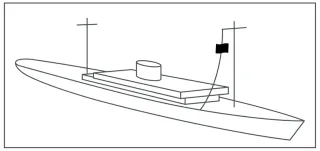
How must you behave towards this vessel?
- A The safe passage of the vessel must not be impeded. Correct
- B The vessel must be passed on the starboard side.
- C Avoid creating suction and wash.
- D Maintain course and speed.
Explanation by Boatpass
The black cylinder identifies a vessel constrained by her draught.
Question 134 · Specific question Coastal
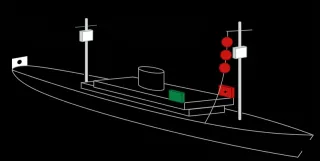
How must you behave towards this vessel?
- A The safe passage of the vessel must not be impeded. Correct
- B The vessel must be passed on the starboard side.
- C Avoid creating suction and wash.
- D Maintain course and speed.
Explanation by Boatpass
Three red all-round lights in a vertical line in addition to the power-driven-vessel lights identify, here, a vessel constrained by her draught underway.
Question 135 · Specific question Coastal
How does the stand-on vessel behave towards a give-way vessel before initiating the last-moment manoeuvre?
- A Initially maintain course and speed and pay particular attention to the give-way vessel. Correct
- B Adjust course or speed and pay particular attention to the give-way vessel.
- C Alter course to starboard, reduce speed and pay particular attention to the give-way vessel.
- D Alter course to starboard, initially maintain speed and pay particular attention to the give-way vessel.
Explanation by Boatpass
The stand-on vessel shall initially keep her course and speed and closely monitor the give-way vessel.
Question 136 · Specific question Coastal
How must a give-way vessel behave towards a stand-on vessel?
- A The avoiding action must be taken early, in a positive manner and be clearly apparent. Correct
- B The course must be adjusted step by step on approaching the stand-on vessel, so as to safely pass astern of the other.
- C The last-moment manoeuvre is to be carried out. The action must be such as to best avoid collision.
- D Speed must be reduced to the minimum required for steerage; if in doubt, the vessel must stop completely.
Explanation by Boatpass
The give-way vessel shall take early and substantial action to keep well clear, in accordance with good seamanship.
Question 137 · Specific question Coastal
How must an overtaking vessel behave?
- A She must give way to the vessel being overtaken. Correct
- B She must keep the greatest possible distance from the overtaken vessel and avoid suction and wash.
- C She must not impede the safe passage of the vessel being overtaken.
- D She must give a sound signal before overtaking to obtain the agreement of the vessel being overtaken.
Explanation by Boatpass
An overtaking vessel shall keep out of the way of the vessel being overtaken.
Question 138 · Specific question Coastal
How must you act in restricted visibility when you hear the sound signal of another vessel apparently forward of your beam?
- A Also give a sound signal and reduce speed to the minimum required for steerage; if necessary stop completely. In any case manoeuvre with caution until the risk of collision has passed. Correct
- B Also give a sound signal and give way early, positively and in a clearly apparent manner.
- C Give at least five short blasts on the whistle and carry out the last-moment manoeuvre such as to best avoid collision.
- D Also give a sound signal. Maintain course and speed until the other vessel comes into sight. Then assess the situation under COLREGs and act accordingly.
Explanation by Boatpass
When, in restricted visibility, a vessel hears apparently forward of her beam the fog signal of another vessel, she shall, except where it has been determined that risk of collision does …
Question 139 · Specific question Coastal
How do you act as stand-on vessel when you find that a give-way vessel is not fulfilling her duty and the danger of an immediate collision is imminent?
- A Give at least five short blasts on the whistle and carry out the 'last-moment manoeuvre', taking such action as will best serve to avoid collision. Correct
- B Give a sound signal (four short blasts) and reduce speed to the minimum required for steerage; if necessary stop completely. In any case manoeuvre with caution until the risk of collision has passed.
- C Give at least five short blasts on the whistle and reduce speed to avoid creating suction and wash.
- D Initially maintain course and speed and pay particular attention to the give-way vessel.
Explanation by Boatpass
When collision cannot be avoided by the action of the give-way vessel alone, the stand-on vessel shall immediately take such action as will best aid to avoid collision.
Question 142 · Specific question Coastal
What must be observed when using a traffic separation scheme?
- A Proceed in the appropriate traffic lane in the general direction of traffic flow; keep as clear as possible of the separation zone/line; enter or leave at the ends of the traffic lane where practicable; when joining or leaving a traffic lane from the side, do so at as small an angle as possible to the general direction of traffic flow. Correct
- B Proceed in the appropriate traffic lane on the left of the separation zone, keep as close as possible to the separation zone/line, enter or leave at the ends of the traffic lane where practicable, join or leave from the side at as near a right angle as possible to the general direction of traffic flow.
- C The use of traffic separation schemes is not permitted for sailing vessels or power-driven vessels under 20 m in length. These vessels shall keep as clear as possible of TSS and must make it clear by their course that they are not using the TSS.
- D Vessels in the traffic lanes proceeding in the general direction of traffic flow shall keep as clear as possible of the separation zone/line and have right of way over all vessels entering or crossing a TSS.
Explanation by Boatpass
A vessel using a traffic separation scheme shall proceed in the appropriate traffic lane in the general direction of traffic flow and, so far as practicable, keep clear of the separation line or zone.
Question 143 · Specific question Coastal
What must be observed when crossing a traffic separation scheme?
- A Crossing should be avoided if possible. If crossing is necessary, it shall be done with the heading (not the track) as nearly as practicable at right angles to the general direction of traffic flow. The heading must also form a right angle to the general direction even if the vessel is set by wind or current. Correct
- B Crossing should be avoided if possible. If crossing is necessary, it shall be done with a true course as nearly as practicable at right angles to the general direction. The true course must also form a right angle even if the vessel is set by wind or current.
- C Crossing of traffic separation schemes is forbidden for sailing vessels and power-driven vessels under 20 m. These vessels must keep clear of the ends of TSS and must show by their course that they are not crossing the TSS.
- D Crossing should be avoided if possible. If crossing is necessary, it shall be done with the heading at as small an angle as possible to the general direction of traffic flow.
Explanation by Boatpass
Crossing traffic lanes should be avoided so far as practicable.
Question 144 · Specific question Coastal
In which regulation are the rules for using traffic separation schemes found?
- A In the Collision Regulations (COLREGs). Correct
- B In the German Maritime Waterways Regulations (SeeSchStrO).
- C In both the Collision Regulations and the Maritime Waterways Regulations.
- D In the notices of the General Directorate of Waterways and Shipping (GDWS).
Explanation by Boatpass
The international conduct rules for traffic separation schemes adopted by the International Maritime Organization (IMO) are set out in Rule 10 of the International Regulations for …
Question 145 · Specific question Coastal
How must a power-driven vessel in a traffic lane of a TSS behave towards a power-driven vessel crossing the lane from starboard when there is risk of collision?
- A She must give way to the other vessel. Correct
- B She must not impede the safe passage of the crossing power-driven vessel.
- C She must pay particular attention to the crossing vessel.
- D She must carry out the last-moment manoeuvre.
Explanation by Boatpass
The other rules of the International Regulations for Preventing Collisions at Sea (COLREGs) continue to apply within a traffic lane unless Rule 10 provides otherwise.
Question 146 · Specific question Coastal
How must a sailing vessel behave when crossing a traffic separation scheme towards a power-driven vessel proceeding in a traffic lane in the general direction of traffic flow?
- A She must not impede the safe passage of the power-driven vessel. Correct
- B She is the stand-on vessel. She must maintain course and speed.
- C She must wait. All vessels following the traffic lane have priority.
- D She has priority. All vessels following the traffic lane must wait.
Explanation by Boatpass
A sailing vessel crossing a traffic separation scheme shall not impede the safe passage of a power-driven vessel following a traffic lane.
Question 147 · Specific question Coastal
How must vessels of less than 20 m in length or sailing vessels behave in traffic separation schemes?
- A They must not impede the safe passage of a power-driven vessel following a traffic lane. Correct
- B They are classified as small craft and may not use traffic separation schemes.
- C They are classified as small craft and may use traffic separation schemes only by day and in good visibility.
- D They may use the separation zone so as not to impede through traffic.
Explanation by Boatpass
Vessels of less than 20 metres in length and sailing vessels shall not impede the safe passage of a power-driven vessel following a traffic lane.
Question 148 · Specific question Coastal
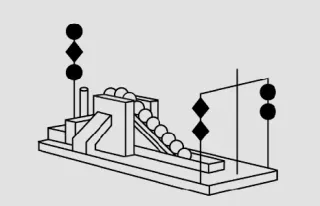
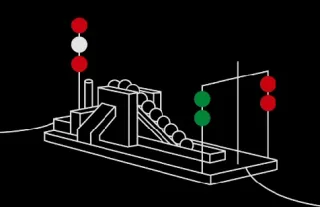
What type of vessel is this and what must be observed?
- A A vessel restricted in ability to manoeuvre engaged in dredging or underwater operations, impeding navigation. She must be passed on the side where two black diamond shapes are displayed in a vertical line. Correct
- B A vessel restricted in ability to manoeuvre, impeding navigation. She must be passed on the side where two black balls are displayed in a vertical line.
- C A vessel restricted in ability to manoeuvre engaged in dredging or underwater operations, impeding navigation. She must be passed on the starboard side of your direction of travel.
- D A vessel restricted in ability to manoeuvre engaged in dredging or underwater operations, impeding navigation. She may not be passed on either side.
Explanation by Boatpass
The vessel is restricted in her ability to manoeuvre because she is engaged in dredging or underwater operations and indicates an obstruction on one side.
Question 149 · Specific question Coastal
What type of vessel is this and what must be observed?
- A A RAM vessel making way, engaged in dredging or underwater operations, NOT impeding navigation. She must be passed on the side to the right in the direction of travel. Correct
- B A RAM vessel making way, engaged in dredging or underwater operations, impeding navigation. She must be passed on the side to the left in the direction of travel.
- C A vessel not under command making way, engaged in dredging or underwater operations, impeding navigation. She must be passed on the side to the right in the direction of travel.
- D A RAM vessel making way, engaged in dredging or underwater operations, impeding navigation. She may be passed on either side.
Explanation by Boatpass
The vessel is restricted in her ability to manoeuvre because she is engaged in dredging or underwater operations, is making way through the water and presents no obstruction on either side.
Question 150 · Specific question Coastal
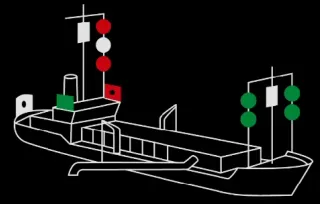
What type of vessel is this and what must be observed?
- A A RAM vessel without way through the water, engaged in dredging or underwater operations, impeding navigation. She must be passed on the side where two green all-round lights are displayed in a vertical line. Correct
- B A RAM vessel without way through the water, impeding navigation. She must be passed on the side where two red all-round lights are displayed in a vertical line.
- C A RAM vessel without way through the water, engaged in dredging or underwater operations, impeding navigation. She must be passed on the left-hand side in the direction of travel.
- D A RAM vessel without way through the water, engaged in dredging or underwater operations, impeding navigation. She must be passed on the starboard side of the fairway (keep-right rule).
Explanation by Boatpass
The vessel is restricted in her ability to manoeuvre because she is engaged in dredging or underwater operations, is not making way through the water and indicates an obstruction on one side.
Question 151 · Specific question Coastal
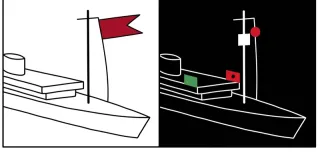
What type of vessel is this and what must be observed?
- A Vessel carrying dangerous goods – keep a safe distance, smoking and open fire prohibited. Correct
- B Government service vessel. It may deviate from the traffic regulations.
- C Vessel in distress. Render assistance or summon further help.
- D Vessel with a diver in the water. Keep a wide distance.
Explanation by Boatpass
By day, International Code flag B, and when lights are required one all-round red light, identify a vessel carrying dangerous goods.
Question 154 · Specific question Coastal
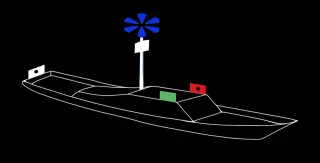
What type of vessel is this and what must be observed?
- A A government service vessel on duty. It may deviate from the traffic regulations. Correct
- B A naval vessel on duty. It has ammunition or other dangerous goods on board.
- C A pilot vessel with special privileges on duty. It may deviate from the keep-right rule.
- D A vessel constrained by her draught. She must not be impeded.
Explanation by Boatpass
The blue flashing-light signal identifies a government service vessel on duty.
Question 155 · Specific question Coastal
Who fires the visual signal 'rockets with white stars' and what must be observed?
- A A naval vessel, Federal Police vessel or a power-driven vessel towing target floats during exercises. Keep clear. Correct
- B A vessel fishing with nets, lines, trawls or other gear, drawing attention to itself. Keep a safe distance.
- C A vessel in distress drawing attention to itself. Render assistance, summon further help if necessary.
- D A power-driven vessel over 50 m requesting a pilot. Maintain course and speed.
Explanation by Boatpass
At night, vessels of the German Armed Forces or Federal Police, and power-driven vessels towing targets, fire rockets showing white stars when another vessel is approaching in a manner that …
Question 165 · Specific question Coastal
How must vessels behave when entering a fairway, crossing a fairway, turning within a fairway or leaving their berths or anchorages?
- A They must observe the right of way of vessels following the course of the fairway. Correct
- B They have right of way over vessels in the fairway.
- C They must give one short blast as an attention signal.
- D They must carry out their manoeuvre so that other vessels are not impeded.
Explanation by Boatpass
Vessels entering or crossing a fairway, turning within it, or leaving an anchorage or berth shall give priority to vessels following the course of the fairway.
Question 166 · Specific question Coastal
How must sailing vessels in the fairway that are not clearly following the direction of the fairway give way to one another?
- A They must give way to one another in accordance with the COLREGs rules, provided they do not thereby endanger or impede vessels with right of way. Correct
- B They must give way to one another in accordance with the German Maritime Waterways Regulations, provided they do not thereby endanger or impede vessels with right of way.
- C They must give way to one another in accordance with the Ems Estuary Traffic Regulations, provided they do not thereby endanger or impede vessels with right of way.
- D They must give way to one another in accordance with the Inland Waterways Traffic Regulations, provided they do not thereby endanger or impede vessels with right of way.
Explanation by Boatpass
Sailing vessels within a fairway that are not clearly following its direction must act between themselves in accordance with the International Regulations for Preventing Collisions at Sea …
Question 167 · Specific question Coastal
Which right-of-way rules apply outside the fairway?
- A The rules of the COLREGs. Correct
- B The rules of the German Maritime Waterways Regulations (SeeSchStrO).
- C The rules of the Ems Estuary Traffic Regulations (EmsSchO).
- D The rules of the Inland Waterways Traffic Regulations (BinSchStrO).
Explanation by Boatpass
Outside the fairway, collision-avoidance duties are generally governed by the International Regulations for Preventing Collisions at Sea (COLREGs).
Question 168 · Specific question Coastal
Where is overtaking prohibited?
- A At narrow passages, blind bends, in lock areas, within stretches marked by no-overtaking signs, and in the vicinity of non-free-running ferries under way. Correct
- B At narrow passages, blind bends, in lock areas, within stretches marked by no-overtaking signs, in the vicinity of non-free-running ferries under way, and outside the fairway.
- C At narrow passages, blind bends, in lock areas, within stretches marked by no-overtaking signs, in the vicinity of non-free-running ferries under way, and in traffic separation schemes.
- D At narrow passages, blind bends, within stretches marked by no-overtaking signs, and in national parks and designated nature conservation areas.
Explanation by Boatpass
Overtaking is prohibited at narrow passages, blind bends, in lock areas, in no-overtaking zones, and in the vicinity of non-free-running ferries under way.
 Boat