SBF Coastal exam questions

Seamanship, safety & distress signals

Towing in a seaway, safety measures before heavy weather, man overboard, capsizing and distress and flag signals. These are the situations at sea where you have to act fast.

Practise for free (opens in a new tab)

out of 5 stars,4.98 · 53 ratings · iOS & Android

All SBF Coastal topics

All 16 questions in this topic

In the official catalogue answer A is always the correct one. “Test yourself” shuffles the answers and only reveals them after you choose.

Question 256 · Specific question Coastal

How long should a tow line be in heavy sea conditions?

  1. At least two to three times the wave length. Correct
  2. At least two to three times the wave height.
  3. At least two to three times the vessel's length.
  4. At least two to three times the water depth.

Explanation by Boatpass

In heavy seas, the towline should be at least two to three wavelengths long.
Question 257 · Specific question Coastal

What must be observed when a recreational craft is to be towed?

  1. The tow line must be adjusted to sea conditions. The towing speed must not exceed the speed the towed vessel can achieve under its own power in displacement mode. Sudden jerking of the tow line must be avoided. Correct
  2. The tow line must be adjusted to sea conditions. The towing speed must not exceed the speed the towing vessel can achieve under its own power in displacement mode. Sudden jerking of the tow line must be avoided.
  3. The tow line must be adjusted to weather conditions. The towing speed must not exceed the speed the towed vessel can achieve under its own power in planing mode. Sudden jerking of the tow line must be avoided.
  4. The tow line must be adjusted to weather conditions. The towing speed must not exceed the speed the towing vessel can achieve under its own power in planing mode. Sudden jerking of the tow line must be avoided.

Explanation by Boatpass

When towing a recreational craft: adjust the tow line to sea conditions, keep towing speed no higher than the towed vessel's displacement speed, and avoid sudden jerking of the line.

Question 258 · Specific question Coastal

How can a disabled recreational craft be kept head-to-wind?

  1. With a sea anchor or other suitable floating objects. Correct
  2. By repeatedly briefly engaging and disengaging the propulsion engine.
  3. With a sea anchor deployed astern or similar floating objects.
  4. With sea anchors deployed fore and aft or other suitable floating objects.

Explanation by Boatpass

A disabled recreational craft can be held bow-to-wind and bow-to-sea by a sufficiently effective sea anchor deployed from the bow, or by suitable floating drag devices.

Question 259 · Specific question Coastal

Why should speed be reduced in heavy sea conditions?

  1. To avoid damage caused by breaking seas. Correct
  2. To prevent the propeller from breaking the surface and to save fuel.
  3. To minimise rolling and pitching movements.
  4. To avoid resonance between vessel length and wave length.

Explanation by Boatpass

Reduce speed in heavy seas to limit pounding or slamming loads on the hull and the resulting risk of damage or injury.

Question 274 · Specific question Coastal

What safety measures must be taken on board as part of seamanlike due care in addition to the rules of conduct prescribed by the Collision Regulations when visibility is reduced?

  1. In particular, use all navigation equipment carefully, increase the vessel's own visibility (e.g. radar reflector, AIS), and in areas with shore radar advisory service, monitor the radar advisory on VHF radio. Correct
  2. In particular, switch on all technical equipment such as radar, AIS, echo sounder, and autopilot, and in areas with shore radar advisory service, request the radar advisory on VHF radio.
  3. In particular, use all navigation equipment carefully, increase the vessel's own visibility (e.g. radar reflector, AIS), and keep the traffic centre continuously informed of course and speed.
  4. In particular, switch on all technical equipment such as radar, echo sounder, AIS, and autopilot, and keep the traffic centre continuously informed of course and speed.

Explanation by Boatpass

In restricted visibility, carefully use all available navigation equipment, improve radar and electronic conspicuity with a correctly rigged radar reflector and, where fitted, a …

Question 275 · Specific question Coastal

What safety measures should be taken at sea before the onset of bad weather?

  1. Make the vessel watertight, lash down loose items, put on a lifejacket and keep other lifesaving equipment ready; if necessary and possible, head for a port of refuge. Correct
  2. Make the vessel watertight, lash down loose items, keep lifejacket and other lifesaving equipment ready, and prepare distress signals for use.
  3. Close doors, lash down loose items, keep lifejacket and other lifesaving equipment ready, and man the radar, helm and VHF.
  4. Close doors, lash down loose items, keep lifejacket and other lifesaving equipment ready, and prepare distress signals for use.

Explanation by Boatpass

Before heavy weather, establish watertight integrity, lash down loose gear, put on lifejackets and have other lifesaving appliances ready; if necessary and possible, make for a port of refuge.

Question 276 · Specific question Coastal

What aids can be used to recover a person drifting in the water?

  1. A line, rescue sling, recovery net, block and tackle, bathing ladder, or the main boom. Correct
  2. A line, bathing ladder, sea anchor, rescue sling, recovery net, block and tackle.
  3. A line, main boom, anchor chain, block and tackle, bathing ladder, rescue sling.
  4. A line, bathing ladder, lifebuoy, recovery net, main boom, block and tackle.

Explanation by Boatpass

Suitable recovery aids are a line connection, recovery sling, recovery net, block and tackle, boarding ladder and the main boom.

Question 277 · Specific question Coastal

What should you do if the vessel has capsized?

  1. If possible stay with the vessel and keep the crew together; avoid unnecessary exhaustion and attract attention to get help. Correct
  2. If possible stay with the vessel and give distress signals. Keep the crew together and avoid unnecessary exhaustion.
  3. If possible stay with the vessel and mark the site of the accident; avoid unnecessary exhaustion and attract attention to get help.
  4. If possible stay with the vessel and keep the crew together; recover valuables and the logbook.

Explanation by Boatpass

After a capsize, stay with the craft if possible and if doing so does not create a greater immediate danger.

Question 278 · Specific question Coastal

How do you prevent persons from falling overboard in rough seas?

  1. Rig safety lines/jackstays, put on a safety harness and clip in at the points provided for it. Correct
  2. Rig safety lines/jackstays, gather the crew on deck, and put on lifejackets.
  3. Coil up the safety lines/jackstays, put on a safety harness and clip into the railing.
  4. Gather the crew in the cockpit, put on lifejackets, and rig safety lines/jackstays.

Explanation by Boatpass

In rough seas, rig suitable jackstays, wear a proper safety harness and clip only to designated strong points.

Question 279 · Specific question Coastal

What distress signals can be used?

  1. A flare/rocket showing a red star or a red hand flare, continuous sounding of a fog-signalling apparatus, three flashes or sounds (• • • – – – • • •) by light or sound, the word MAYDAY three times by radiotelephony, slowly raising and lowering outstretched arms, flag signal NC, EPIRB, DSC, radar transponder (SART). Correct
  2. A rocket showing a red star or a red hand flare, continuous sounding of a fog-signalling apparatus, three signals (• • • – – – • • •) by light or sound, sea marker dye, slowly raising and lowering outstretched arms, a ball above or below flag signal NC, EPIRB, DSC, radar transponder.
  3. A rocket showing an orange star or an orange hand flare, a red smoke signal, continuous sounding of a fog-signalling apparatus, three signals (• • • – – – • • •) by light or sound, the word MAYDAY three times by radiotelephony, slowly raising and lowering outstretched arms, flag signal NC, EPIRB, DSC, radar transponder.
  4. A rocket showing a red star or a red hand flare, continuous sounding of a fog-signalling apparatus, three signals (– – – • • • – – –) by light or sound, the word MAYDAY three times by radiotelephony, slowly raising and lowering outstretched arms, flag signal NC, EPIRB, DSC, radar transponder.

Explanation by Boatpass

Distress signals include a rocket showing a red star, a red hand flare, continuous sounding of a fog-signalling apparatus, the Morse distress signal (SOS) (`...---...`) made by light or …

Question 280 · Specific question Coastal

What does the flag signal 'NC' displayed on a vessel mean?

  1. Vessel in distress. Correct
  2. Government service vessel.
  3. Vessel carrying dangerous goods.
  4. Vessel leaving berth.

Explanation by Boatpass

The November-Charlie flag signal (NC) – flags N and C hoisted together – means that the vessel is in distress.

Question 281 · Specific question Coastal

What does the continuous sounding of a fog signalling device from a vessel mean?

  1. Vessel in distress. Correct
  2. Vessel carrying dangerous goods.
  3. Keep-clear signal.
  4. Attention signal.

Explanation by Boatpass

Continuous sounding with any fog-signalling apparatus is an international distress signal indicating distress and need of assistance.

Question 282 · Specific question Coastal

What does the following Morse signal mean when given by light or sound (• • • – – – • • •)?

  1. Distress signal. Correct
  2. Fog signal.
  3. Keep-clear signal.
  4. Overtaking signal.

Explanation by Boatpass

The Morse distress signal (SOS) – three dots, three dashes, three dots – is an international distress signal when made by light or sound.

Question 283 · Specific question Coastal

What does a rocket with a red star signify?

  1. Maritime distress. Correct
  2. Request to stop.
  3. Shooting exercise.
  4. Request to alter course.

Explanation by Boatpass

A rocket showing a red star means distress. Annex IV of the International Regulations for Preventing Collisions at Sea (COLREGs) lists rockets or shells throwing red stars, fired one at a …

Question 284 · Specific question Coastal

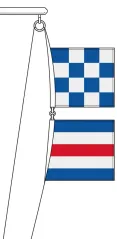
What does the following flag signal mean?

SBF Coastal exam question 284 – figure
  1. Vessel in distress. Correct
  2. Government service vessel.
  3. Vessel carrying dangerous goods.
  4. Vessel leaving berth.

Explanation by Boatpass

The signal shown—flag N (November) over flag C (Charlie)—is the November-Charlie flag signal (NC) of the International Code of Signals and means “vessel in distress”.

Question 285 · Specific question Coastal

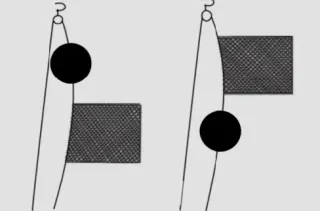
What does one of the following signals on a vessel mean?

SBF Coastal exam question 285 – figure
  1. Vessel in distress. Correct
  2. Vessel restricted in ability to manoeuvre.
  3. Vessel carrying dangerous goods.
  4. Vessel at anchor, more than 100 m in length.

Explanation by Boatpass

The signal shown – a square flag with a ball (or ball-like object) above or below it – is one of the distress signals under Annex IV of the International Regulations for Preventing …

Keep practising

Sources and status

  • Questions and answers: official German question and answer catalogue, SBF Coastal at www.elwis.de , valid since 1 August 2023. Issued by the German Federal Ministry for Digital and Transport (BMDV) and published in the Verkehrsblatt.
  • Current version: BMDV notices of 28 April 2023 amending the catalogues SBF Coastal (PDF) , in force since 1 August 2023.
  • The German wording of questions and answers is reproduced unchanged; obvious typos in the catalogue are corrected. In the official catalogue answer a is always the correct one. The grouping into topics is by Boatpass; the official catalogue only distinguishes basic and specific questions.
  • The official catalogue and the exam are in German. The English text is an unofficial translation by Boatpass for learning purposes; only the German wording is authoritative.
  • Figures based on the official question catalogue (ELWIS), some redrawn by Boatpass.
  • “Explanation by Boatpass”: original texts by Boatpass, shown here as an excerpt; the full explanations and memory aids are in the app. © Boatpass, reproduction only with permission.

Ready for your exam?

15 questions a day across all licences, no account and no payment details.

Download for free

iPhone · iPad · Android