SBF Coastal exam questions

Sound signals & restricted visibility

Fog signals, manoeuvring signals, the general danger and warning signal and conduct in restricted visibility. Remember the signals as a rhythm (long, short, short), then the answers are easy to tell apart.

Practise for free (opens in a new tab)

out of 5 stars,4.98 · 53 ratings · iOS & Android

All SBF Coastal topics

All 19 questions in this topic

In the official catalogue answer A is always the correct one. “Test yourself” shuffles the answers and only reveals them after you choose.

Question 116 · Specific question Coastal

In restricted visibility you hear at least one prolonged blast from a whistle every two minutes. Which vessel gives this signal?

  1. A power-driven vessel making way through the water. Correct
  2. A vessel being towed or the last manned vessel of a tow underway.
  3. A vessel with dangerous cargo at anchor, less than 100 m in length.
  4. A vessel at anchor, 100 m or more in length.

Explanation by Boatpass

In or near an area of restricted visibility, a power-driven vessel making way through the water shall sound one prolonged blast at intervals of not more than two minutes, by day or by night.
Question 117 · Specific question Coastal

In restricted visibility you hear at least two consecutive prolonged blasts from a whistle every two minutes. Which vessel gives this signal?

  1. A power-driven vessel underway that has stopped her engines and is not making way through the water. Correct
  2. A vessel being towed or the last manned vessel of a tow underway.
  3. A vessel with dangerous cargo at anchor, less than 100 m in length.
  4. A vessel at anchor, 100 m or more in length.

Explanation by Boatpass

A power-driven vessel underway but stopped and making no way through the water shall sound two prolonged blasts in succession, with an interval of about two seconds between them, at …

Question 118 · Specific question Coastal

Which vessels give in restricted visibility at least every two minutes three consecutive tones on the whistle: one prolonged followed by two short blasts?

  1. A vessel not under command underway, a RAM vessel underway or at anchor, a vessel constrained by draught underway, a sailing vessel underway, a vessel towing or pushing underway, a fishing vessel underway or at anchor. Correct
  2. A vessel not under command underway, a RAM vessel underway or at anchor, a vessel constrained by draught underway, a power-driven vessel making way, a vessel towing or pushing underway, a fishing vessel underway or at anchor.
  3. A vessel not under command underway, a RAM vessel underway or at anchor, a vessel constrained by draught underway, a sailing vessel underway, a vessel towing or pushing underway, a fishing vessel underway or at anchor, a power-driven vessel that has stopped engines and is not making way.
  4. A vessel not under command underway, a RAM vessel underway or at anchor, a vessel constrained by draught underway, a sailing vessel underway, a vessel towing or pushing underway, a vessel being towed or the last manned vessel of a tow underway, a fishing vessel underway or at anchor.

Explanation by Boatpass

One prolonged blast followed by two short blasts at intervals of not more than two minutes is sounded by a vessel not under command, a vessel restricted in her ability to manoeuvre, a …

Question 119 · Specific question Coastal

In restricted visibility, which vessel gives – following the signal prolonged-short-short – four consecutive tones on the whistle: prolonged-short-short-short?

  1. A vessel being towed or the last manned vessel of a tow underway. Correct
  2. A power-driven vessel underway that has stopped her engines and is not making way.
  3. A vessel with dangerous cargo at anchor, less than 100 m in length.
  4. A vessel not under command, less than 100 m in length.

Explanation by Boatpass

A vessel being towed, or if more than one vessel is towed the last vessel of the tow, if manned, shall sound one prolonged blast followed by three short blasts at intervals of not more than …

Question 120 · Specific question Coastal

What sound signal must a sailing vessel of 12 m or more in length give when underway in restricted visibility?

  1. At least every two minutes three consecutive tones on the whistle (– • •): prolonged, short, short. Correct
  2. At least every two minutes three consecutive tones on the whistle (– – •): prolonged, prolonged, short.
  3. At least every two minutes a strong sound signal that cannot be confused with the prescribed signals.
  4. On the whistle (• – •): short, prolonged, short.

Explanation by Boatpass

A sailing vessel underway and 12 metres or more in length shall sound one prolonged blast followed by two short blasts at intervals of not more than two minutes in or near an area of …

Question 121 · Specific question Coastal

What sound signal must a vessel underway of less than 12 m in length give in restricted visibility if she cannot give the otherwise prescribed signals?

  1. At least every two minutes a strong sound signal that cannot be confused with the prescribed signals. Correct
  2. At least every two minutes three consecutive tones on the whistle (– • •): prolonged, short, short.
  3. At least every two minutes three consecutive tones on the whistle (– – •): prolonged, prolonged, short.
  4. On the whistle (• – •): short, prolonged, short.

Explanation by Boatpass

A vessel of less than 12 metres in length is not obliged to give the otherwise prescribed sound signals, but if she does not, she shall make some other efficient sound signal, not liable to …

Question 122 · Specific question Coastal

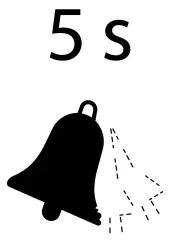
Which vessel rings a bell rapidly for about 5 seconds at least every minute in restricted visibility?

SBF Coastal exam question 122 – figure
  1. A vessel at anchor, less than 100 m in length. Correct
  2. A vessel at anchor, 100 m or more in length.
  3. A vessel being towed or the last manned vessel of a tow underway.
  4. A power-driven vessel underway that has stopped her engines and is not making way.

Explanation by Boatpass

A vessel at anchor and less than 100 metres in length shall ring the bell rapidly for about five seconds at intervals of not more than one minute in or near an area of restricted visibility.

Question 123 · Specific question Coastal

Which vessel rings a bell rapidly for about 5 seconds followed immediately by a gong sounded rapidly for about 5 seconds, at least every minute in restricted visibility?

SBF Coastal exam question 123 – figure 1SBF Coastal exam question 123 – figure 2
  1. A vessel at anchor, 100 m or more in length. Correct
  2. A vessel at anchor, less than 100 m in length.
  3. A vessel being towed or the last manned vessel of a tow underway.
  4. A power-driven vessel underway that has stopped her engines and is not making way.

Explanation by Boatpass

A vessel at anchor 100 metres or more in length rapidly rings the bell in the forepart for about five seconds and immediately afterwards rapidly sounds the gong in the after part for about …

Question 124 · Specific question Coastal

What additional sound signal may any vessel at anchor give in restricted visibility to indicate her position to an approaching vessel?

  1. On the whistle (• – •): short, prolonged, short. Correct
  2. At least every two minutes a strong sound signal that cannot be confused with the prescribed signals.
  3. At least every two minutes three consecutive tones on the whistle (– • •): prolonged, short, short.
  4. At least every two minutes three consecutive tones on the whistle (– – •): prolonged, prolonged, short.

Explanation by Boatpass

A vessel at anchor may additionally sound one short, one prolonged and one short blast on the whistle to indicate her position and warn an approaching vessel of the possibility of collision.

Question 140 · Specific question Coastal

What does the following sound signal mean? (at least • • • • •)

  1. A give-way vessel is being reminded of her duty to give way. Correct
  2. General danger and warning signal.
  3. Keep-clear signal – danger of explosion due to dangerous goods. Leave the danger area immediately. Avoid fire and ignition.
  4. Shipping lane closed. Sailing prohibited, stop immediately.

Explanation by Boatpass

Five (or more) short and rapid blasts are the doubt or attention signal of the International Regulations for Preventing Collisions at Sea (COLREGs): a vessel in sight sounds it when in …

Question 141 · Specific question Coastal

What does the following sound signal mean (• – •)?

  1. A vessel at anchor is warning an approaching vessel of a dangerous approach. Correct
  2. The vessel's engines are running astern.
  3. Protected structure – reduce speed, avoid suction and wash.
  4. Power-driven vessel that has stopped her engines and is not making way.

Explanation by Boatpass

A vessel at anchor sounds (• – •) to warn an approaching vessel of her position in restricted visibility.

Question 161 · Specific question Coastal

What sound signal must be given when entering a fairway or harbour if the traffic situation requires it?

  1. One prolonged blast. Correct
  2. One short blast.
  3. One short and one prolonged blast.
  4. One prolonged and one short blast.

Explanation by Boatpass

When the traffic situation requires an attention signal while entering another fairway or a harbour, one prolonged blast is sounded on German maritime waterways other than the Kiel Canal.

Question 162 · Specific question Coastal

What does the following sound signal mean (– • • • • – • • • •)?

  1. General 'danger and warning signal'. Correct
  2. Closure of the maritime waterway.
  3. Stop immediately (government service vessel).
  4. Bridge/lock cannot be opened temporarily.

Explanation by Boatpass

The general danger and warning signal (– • • • • – • • • •): two groups each of one prolonged and four short blasts.

Question 163 · Specific question Coastal

What is the 'general danger and warning signal'?

  1. Two groups each consisting of one prolonged and four short blasts. Correct
  2. Two groups each consisting of three prolonged blasts.
  3. Two groups each consisting of four short blasts.
  4. Two groups each consisting of one short and four prolonged blasts.

Explanation by Boatpass

The general danger and warning signal under the German Maritime Waterways Regulations (SeeSchStrO) consists of two successive groups, each comprising one prolonged blast followed by four short blasts.

Question 164 · Specific question Coastal

When is the 'general danger and warning signal' to be given?

  1. When a vessel is endangering another vessel or is itself being endangered by one. Correct
  2. When a vessel wishes to overtake another vessel in the fairway on the starboard side.
  3. When a vessel cannot give way to another.
  4. When a vessel calls on another vessel for assistance.

Explanation by Boatpass

The general danger and warning signal is given when a vessel is endangering another or when it is itself being endangered.

Question 178 · Specific question Coastal

What is the meaning of the following sound signal (• • • •) and what must be observed?

  1. Bridge, barrage, or lock cannot be opened temporarily; stop and wait for clearance. Correct
  2. A give-way vessel is reminded of its obligation to give way by the stand-on vessel; initiate an avoiding manoeuvre immediately.
  3. Keep-away signal due to dangerous cargo; leave the danger zone immediately. Avoid open flames (risk of explosion).
  4. Bridge, barrage, or lock is being prepared for opening; continue.

Explanation by Boatpass

This sound signal (• • • •) means: a bridge, barrage, or lock cannot be opened temporarily.

Question 186 · Specific question Coastal

What is the meaning of the following sound signal (• – • •)?

  1. Police vessel ordering a stop. Correct
  2. Vessel at anchor drawing attention to a dangerous approach.
  3. Last manned vessel in a tow.
  4. Vessel restricted in ability to manoeuvre blocking the fairway.

Explanation by Boatpass

The sound signal short–prolonged–short–short means that a police vessel is ordering a vessel to stop.

Question 188 · Specific question Coastal

What is the meaning of the following sound signal (– – – – – –)?

  1. Closure of the sea waterway, further passage prohibited. Correct
  2. Entry into lock or installation prohibited; wait for clearance.
  3. A vessel at anchor in poor visibility; navigate cautiously.
  4. Public service vessel; stop.

Explanation by Boatpass

Two groups of three prolonged blasts are sound signal C.4 for closure of the sea waterway: further passage is prohibited.

Question 271 · Specific question Coastal

How must a vessel navigate in the fairway in reduced visibility, in accordance with the seamanlike duty of care, when the vessel lacks the technical equipment — in particular for detecting other vessels?

  1. Leave the fairway and, if possible, seek shallow water and anchor. If this is not possible, keep as far to the right as possible within the fairway. Correct
  2. Stop immediately and anchor; if this is not possible, proceed cautiously and keep as close as possible to the wake of a vessel ahead.
  3. Continue at a steady pace so as not to obstruct other traffic. When hearing sound signals from others, stop and wait, continuously taking depth soundings.
  4. Keep as far to the right as possible within the fairway and make for the nearest harbour or berth. If in doubt, ask other vessels for position and correct course.

Explanation by Boatpass

In restricted visibility, a vessel lacking technical equipment, particularly equipment for detecting other vessels, must leave the fairway as a matter of good seamanship.

Keep practising

Sources and status

  • Questions and answers: official German question and answer catalogue, SBF Coastal at www.elwis.de , valid since 1 August 2023. Issued by the German Federal Ministry for Digital and Transport (BMDV) and published in the Verkehrsblatt.
  • Current version: BMDV notices of 28 April 2023 amending the catalogues SBF Coastal (PDF) , in force since 1 August 2023.
  • The German wording of questions and answers is reproduced unchanged; obvious typos in the catalogue are corrected. In the official catalogue answer a is always the correct one. The grouping into topics is by Boatpass; the official catalogue only distinguishes basic and specific questions.
  • The official catalogue and the exam are in German. The English text is an unofficial translation by Boatpass for learning purposes; only the German wording is authoritative.
  • Figures based on the official question catalogue (ELWIS), some redrawn by Boatpass.
  • “Explanation by Boatpass”: original texts by Boatpass, shown here as an excerpt; the full explanations and memory aids are in the app. © Boatpass, reproduction only with permission.

Ready for your exam?

15 questions a day across all licences, no account and no payment details.

Download for free

iPhone · iPad · Android