Question 104 · Specific question Inland
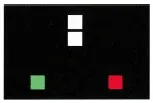
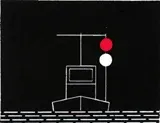
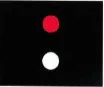
What do two white lights on top of each other mean on a stationary vessel?
- A A vessel at anchor whose anchor may endanger navigation. Correct
- B A stationary pushed convoy.
- C A vessel at anchor that has deployed two anchors.
- D A vessel more than 135 m long.
Explanation by Boatpass
The normal white stationary light plus an additional white all-round light below it marks a vessel at anchor whose anchor, cable, or chain may endanger navigation.
Question 105 · Specific question Inland
What light must a stationary vessel show?
- A A white all-round light on the fairway side. Correct
- B A white masthead light and a white stern light.
- C The side lights and a visible all-round white light.
- D A white flashing light visible from all sides on the fairway side.
Explanation by Boatpass
At night, a stationary vessel shows a white all-round light on the fairway side.
Question 106 · Specific question Inland
How are anchors that could obstruct navigation marked by day?
- A With a yellow marker buoy. Correct
- B With a white marker buoy.
- C With a green marker buoy.
- D With a red marker buoy.
Explanation by Boatpass
An anchor that could obstruct navigation is marked by day with a yellow marker buoy, known in German as a Döpper.
Question 120 · Specific question Inland
What do these lights mean?
- A Power-driven vessel more than 110 m long. Correct
- B Pushed convoy less than 110 m long.
- C Pushed convoy more than 110 m long.
- D Vessel without mechanical propulsion more than 110 m long.
Explanation by Boatpass
A single power-driven vessel more than 110 metres long shows a second masthead light on the after part in addition to the forward masthead light.
Question 121 · Specific question Inland
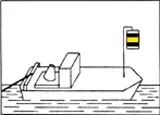
What does this day signal mean?
- A Power-driven towing vessel at the head of a tow. Correct
- B Vessel lying at anchor.
- C Vessels with priority at a lock.
- D Vessel in a tow.
Explanation by Boatpass
The yellow cylinder with black and white border stripes is the day signal of the power-driven vessel at the head of a tow.
Question 122 · Specific question Inland
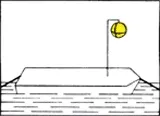
What does this day signal mean?
- A Vessel in a tow. Correct
- B Vessel lying at anchor.
- C Vessels with priority at a lock.
- D Power-driven towing vessel at the head of a tow.
Explanation by Boatpass
The yellow ball is the day signal of a towed vessel underway as part of a tow.
Question 123 · Specific question Inland
What do these lights mean?
- A Pushed convoy under way, seen from ahead. Correct
- B Pushed convoy under way, seen from astern.
- C Pushed convoy at anchor.
- D Pushed convoy less than 110 m long.
Explanation by Boatpass
Seen from ahead, a pushed convoy is identified by three white masthead lights arranged as a triangle and by its sidelights.
Question 124 · Specific question Inland
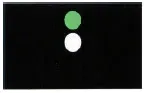
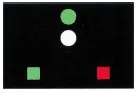
What do these lights mean?
- A Ferry-boat not moving independently. Correct
- B Ferry-boat moving independently.
- C Pushed convoy seen from astern.
- D Pushed convoy seen from starboard.
Explanation by Boatpass
At night, a ferry-boat not moving independently shows only two all-round lights: a white one with a green one about one metre above it.
Question 125 · Specific question Inland
What do these lights mean?
- A Ferry-boat moving independently. Correct
- B Ferry-boat not moving independently.
- C Pushed convoy seen from astern.
- D Pushed convoy seen from starboard.
Explanation by Boatpass
At night, a ferry-boat moving independently shows green over white all-round lights plus sidelights and a sternlight.
Question 126 · Specific question Inland
What does a blue light mean on a vessel?
- A The vessel is carrying specified flammable substances; the minimum distance while stationary is 10 metres. Correct
- B The vessel is carrying specified substances hazardous to health; the minimum distance while stationary is 50 metres.
- C The vessel is carrying specified explosive substances; the minimum distance while stationary is 100 metres.
- D A vessel of a supervisory authority on duty.
Explanation by Boatpass
One blue light identifies a vessel carrying specified flammable substances.
Question 127 · Specific question Inland
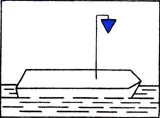
What does this day signal mean?
- A The vessel is carrying specified flammable substances; the minimum distance while stationary is 10 metres. Correct
- B The vessel is carrying specified substances hazardous to health; the minimum distance while stationary is 50 metres.
- C The vessel is carrying specified explosive substances; the minimum distance while stationary is 100 metres.
- D A vessel of a supervisory authority on duty.
Explanation by Boatpass
This day signal (one blue cone, point downward) is the daytime marking for a vessel carrying flammable substances.
Question 128 · Specific question Inland
What do two blue lights on top of each other mean on a vessel?
- A The vessel is carrying specified substances hazardous to health; the minimum distance while stationary is 50 m. Correct
- B The vessel is carrying specified explosive substances; the minimum distance while stationary is 100 m.
- C The vessel is carrying specified flammable substances; the minimum distance while stationary is 10 m.
- D A vessel of a supervisory authority on duty.
Explanation by Boatpass
Two blue lights vertically mark a vessel carrying specified substances hazardous to health.
Question 129 · Specific question Inland
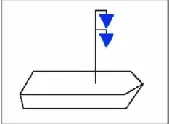
What does this day signal mean?
- A The vessel is carrying specified substances hazardous to health; the minimum distance while stationary is 50 metres. Correct
- B The vessel is carrying specified explosive substances; the minimum distance while stationary is 100 metres.
- C The vessel is carrying specified flammable substances; the minimum distance while stationary is 10 metres.
- D A vessel of a supervisory authority on duty.
Explanation by Boatpass
Two blue cones, points downward, identify by day a vessel carrying specified substances hazardous to health.
Question 130 · Specific question Inland
What do three blue lights on top of each other mean on a vessel?
- A The vessel is carrying specified explosive substances; the minimum distance while stationary is 100 m. Correct
- B The vessel is carrying specified substances hazardous to health; the minimum distance while stationary is 50 m.
- C The vessel is carrying specified flammable substances; the minimum distance while stationary is 10 m.
- D A vessel of a supervisory authority on duty.
Explanation by Boatpass
Three blue lights vertically mark a vessel carrying specified explosive substances.
Question 131 · Specific question Inland
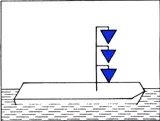
What does this day signal mean?
- A The vessel is carrying specified explosive substances; the minimum distance while stationary is 100 metres. Correct
- B The vessel is carrying specified substances hazardous to health; the minimum distance while stationary is 50 metres.
- C The vessel is carrying specified flammable substances; the minimum distance while stationary is 10 metres.
- D A vessel of a supervisory authority on duty.
Explanation by Boatpass
Three blue cones, points downward, identify by day a vessel carrying specified explosive substances.
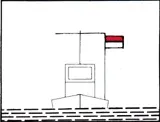
Question 132 · Specific question Inland
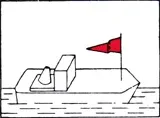
Which vessel carries the following day marking?
- A A vessel granted priority by the competent authority at places where a prescribed order of passage applies. Correct
- B A vessel less than 20 metres long authorised to carry more than 12 passengers.
- C A vessel being towed as part of a tow.
- D A stranded vessel that cannot be passed on one side.
Explanation by Boatpass
The red pennant identifies a vessel granted priority by the competent authority at places where a prescribed order of passage applies.
Question 133 · Specific question Inland
A small vessel under sail travels on an inland waterway at night and has a white all-round light in its masthead. How is the white hand lamp, which must be shown when other vessels approach, best used?
- A Light up your own sails. Correct
- B Light up the water.
- C Light up the approaching vessel.
- D Hold the hand lamp upwards.
Explanation by Boatpass
A small sailing vessel navigating at night with a white all-round light must also show a white hand lamp when other vessels approach.
Question 134 · Specific question Inland
A small vessel under sail travels on an inland waterway at night and has a white all-round light in its masthead. What additional lights need to be set when the engine is started?
- A Sidelights directly beside each other or combined in a single lantern. Correct
- B A white flashing light must be shown.
- C No additional light needs to be used.
- D A second white masthead light must be shown.
Explanation by Boatpass
Once the engine is used for propulsion, the sailing small craft is treated as a power-driven small craft.
Question 135 · Specific question Inland
What lights must a power-driven small craft show when towing another small craft without engine propulsion?
- A The lights prescribed for a power-driven small craft. Correct
- B Two white lights, one above the other.
- C One white all-round light.
- D The lights prescribed for a power-driven small craft and a second white masthead light.
Explanation by Boatpass
When a power-driven small craft tows only other small craft, it must show at night the lights prescribed for a power-driven small craft.
Question 136 · Specific question Inland
What lights must a towed small vessel have?
- A A white all-round light. Correct
- B The lights prescribed for a power-driven small craft.
- C Two white lights, one above the other.
- D A white scintillating light.
Explanation by Boatpass
At night, a towed or side-by-side coupled small craft must show one ordinary white all-round light.
Question 137 · Specific question Inland
When is a pleasure boat no longer considered a small vessel on inland waterways?
- A If it is 20m or longer. Correct
- B If it is 15m or longer.
- C If it is 10m or longer.
- D If it is 18m or longer.
Explanation by Boatpass
As soon as a pleasure craft is 20 metres or longer, it is no longer classified as a small craft.
Question 138 · Specific question Inland
What arcs of visibility and colours are prescribed for the navigation lights on board?
- A Masthead light: white 225°, stern light 135° white, side lights: port red and starboard green, each 112.5°. Correct
- B Masthead light: white 135°, stern light 225° white, side lights: port red and starboard green, each 112.5°
- C Masthead light: white 225°, stern light 112.5° white, side lights: port red and starboard green, each 135°
- D Masthead light: white 112.5°, stern light 225° white, side lights: port red and starboard green, each 112.5°
Explanation by Boatpass
The white masthead light has an arc of visibility of 225 degrees and the white stern light 135 degrees.
Question 139 · Specific question Inland
What is the minimum light required on a small craft not using an engine?
- A A white all-round light. Correct
- B A tricolour lantern at the masthead.
- C Sidelights.
- D A masthead light and a sternlight.
Explanation by Boatpass
The minimum light is one ordinary white all-round light.
Question 145 · Specific question Inland
What do these lights mean?
- A Floating equipment at work. Passage is permitted on either side. Avoid suction and wash. Correct
- B Floating equipment at work. Passage is prohibited.
- C Stranded or sunken vessel. Passage is permitted on the starboard side. Avoid suction and wash.
- D Stranded or sunken vessel. Passage is prohibited.
Explanation by Boatpass
The picture shows floating equipment at work that may be passed on either side.
Question 146 · Specific question Inland
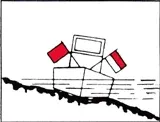
What do these visual signs mean?
- A Floating equipment at work. Passage is permitted on either side. Avoid suction and wash. Correct
- B Floating equipment at work. Passage is prohibited.
- C Stranded or sunken vessel. Passage is permitted on the starboard side. Avoid suction and wash.
- D Stranded or sunken vessel. Passage is prohibited.
Explanation by Boatpass
The red-and-white day signals identify floating equipment at work that must be protected against suction and wash.
Question 147 · Specific question Inland
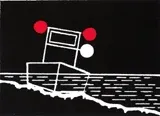
What do these lights mean?
- A Stranded or sunken vessel. Passage is permitted on the red-over-white side; the side showing red only is closed. Avoid suction and wash. Correct
- B Stranded or sunken vessel. Passage is permitted on the red-over-white side; the side showing red only is closed. Passage at undiminished speed is permitted.
- C Stranded or sunken vessel. Passage is permitted on the side showing red only; the red-over-white side is closed. Passage at undiminished speed is permitted.
- D Stranded or sunken vessel. Passage is permitted on the side showing red only; the red-over-white side is closed. Avoid suction and wash.
Explanation by Boatpass
For a stranded or sunken vessel, the red-over-white side marks the side open to passage; the side showing red only is closed.
Question 148 · Specific question Inland
What do these visual signs mean?
- A Stranded or sunken vessel. Passage is permitted on the red-and-white side; the red side is closed. Avoid suction and wash. Correct
- B Stranded or sunken vessel. Passage is permitted on the red-and-white side; the red side is closed. Passage at unreduced speed is permitted.
- C Stranded or sunken vessel. Passage is permitted on the red side; the red-and-white side is closed. Passage at unreduced speed is permitted.
- D Stranded or sunken vessel. Passage is permitted on the red side; the red-and-white side is closed. Avoid suction and wash.
Explanation by Boatpass
The day signals identify a stranded or sunken vessel.
Question 149 · Specific question Inland
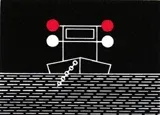
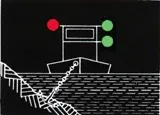
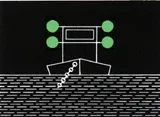
What do these lights mean?
- A Floating equipment at work. Passage is permitted on the green side; the red side is closed. Correct
- B Floating equipment at work. Passage is permitted on the green side; the red side is closed. Avoid suction and wash.
- C Floating equipment at work. Passage is permitted on the green side. The red side may be passed at undiminished speed.
- D Floating equipment at work. Passage is permitted on the red side; the green side is closed.
Explanation by Boatpass
On floating equipment at work, two green lights vertically mark the side open to passage.
Question 150 · Specific question Inland
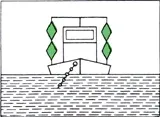
What do these visual signs mean?
- A Floating equipment at work. Passage is permitted on the green side; the red side is closed. Correct
- B Floating equipment at work. Passage is permitted on the green side; the red side is closed. Avoid creating suction or wash.
- C Floating equipment at work. Passage is permitted on the green side. Passage on the red side at unreduced speed is possible.
- D Floating equipment at work. Passage is permitted on the red side; the green side is closed.
Explanation by Boatpass
The day signals identify floating equipment at work.
Question 151 · Specific question Inland
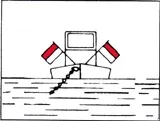
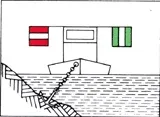
What do the signs below mean in the fairway?
- A Floating equipment at work. Passage is permitted on the side showing the green-white-green board; the red-white-red side is closed. Correct
- B Stranded or sunken vessel. Passage is permitted on the side showing the green-white-green board; the red-white-red side is closed. Avoid suction and wash.
- C Floating equipment at work. Passage is permitted on the side showing the green-white-green board; the red-white-red side is closed. Avoid suction and wash.
- D Stranded or sunken vessel. Passage is permitted on the side showing the red-white-red board; the green-white-green side is closed.
Explanation by Boatpass
On floating equipment at work, the green-white-green board marks the side open to passage.
Question 152 · Specific question Inland
What do these lights mean?
- A Floating equipment at work. Passage is permitted on both sides. Correct
- B Floating equipment at work. Passage is prohibited.
- C Stranded or sunken vessel. Passage is permitted on the starboard side.
- D Stranded or sunken vessel. Passage is prohibited.
Explanation by Boatpass
Two green lights vertically on each side identify floating equipment at work that may be passed on either side.
Question 153 · Specific question Inland
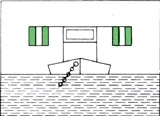
What do these visual signs mean?
- A Floating equipment at work. Passage is permitted on both sides. Correct
- B Floating equipment at work. Passage is prohibited.
- C Stranded or sunken vessel. Passage is permitted on the starboard side.
- D Stranded or sunken vessel. Passage is prohibited.
Explanation by Boatpass
The day signals identify floating equipment at work.
Question 154 · Specific question Inland
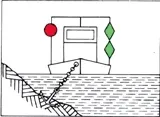
What do these visual signs mean?
- A Floating equipment at work. Passage is permitted on both sides. Correct
- B Floating equipment at work. Passage is prohibited.
- C Stranded or sunken vessel. Passage is permitted on the starboard side. Avoid suction and wash.
- D Stranded or sunken vessel. Passage is prohibited.
Explanation by Boatpass
Green-white-green boards show by day the side on which you may pass floating equipment at work.
Question 155 · Specific question Inland
What does this day and night designation mean?
- A Vessel requiring protection: keep as far away as possible, reduce speed, and avoid suction and wash. Correct
- B Stranded or sunken vessel. Passage is prohibited.
- C Stranded or sunken vessel. Passage is permitted on both sides at unreduced speed.
- D Floating installation or floating object: keep as far away as possible, reduce speed, and avoid suction and wash.
Explanation by Boatpass
The red-and-white flag by day, or a red light above a white light by night, indicates protection against suction and wash.
Question 171 · Specific question Inland
A vessel displays a blue board with a white scintillating light on the starboard side of its wheelhouse. What does this signal mean?
- A Vessels meet starboard-to-starboard. This signal does not apply to small craft, but it requires them to pay increased attention. Correct
- B Vessels meet starboard-to-starboard. This signal applies only to small craft.
- C Vessels meet starboard-to-starboard. This signal need not be observed at all.
- D Vessels meet starboard-to-starboard. This signal also applies to all small craft.
Explanation by Boatpass
The blue board with a white scintillating light indicates that the vessels concerned are meeting starboard-to-starboard.
Question 178 · Specific question Inland
Which vessels underway show only one white all-round light at night?
- A Small craft being towed or coupled alongside. Correct
- B Power-driven small craft less than 20 metres long.
- C Power-driven small craft and vessels being towed.
- D Vessels being pushed.
Explanation by Boatpass
At night, a towed or alongside-coupled small craft shows one ordinary white all-round light.
Question 196 · Specific question Inland
What do the lights below mean on an inland waterway at night?
- A Avoid suction and wash. Correct
- B Passage is prohibited for small craft.
- C Navigation is closed.
- D Passage is permitted for small craft.
Explanation by Boatpass
A red light above a white light indicates that the vessel or floating equipment must be protected from suction and wash.
Question 246 · Specific question Inland
What lights does a pushed convoy show?
- A Three white masthead lights arranged in a triangle, the sidelights, and three white stern lights arranged horizontally side by side. Correct
- B Three white masthead lights arranged vertically, the sidelights, and three white stern lights arranged horizontally side by side.
- C Three white masthead lights arranged in a triangle, the sidelights, and two white stern lights arranged horizontally side by side.
- D Three white masthead lights arranged horizontally side by side, the sidelights, and three white stern lights arranged horizontally side by side.
Explanation by Boatpass
A pushed convoy shows three white masthead lights arranged in a triangle, sidelights (red port, green starboard), and three white stern lights positioned horizontally side by side.
Question 247 · Specific question Inland
Which vessel has a red pennant on its bow?
- A A vessel with priority at locks. Correct
- B A vessel with priority when loading and unloading.
- C A vessel carrying explosive substances.
- D A vessel carrying flammable substances.
Explanation by Boatpass
A red pennant at the bow indicates: this vessel has been granted priority at locks by the competent authority.
Question 248 · Specific question Inland
When is a pleasure boat considered a small craft on inland waterways?
- A If the vessel is less than 20 m long. Correct
- B If the vessel is 20 m long.
- C If the vessel is 25 m long.
- D If the vessel is longer than 20 m.
Explanation by Boatpass
A pleasure boat counts as a small craft if it is less than 20 metres long.
Question 249 · Specific question Inland
What does a red-and-white flag on a vessel mean, and what must be observed?
- A A vessel requiring protection; reduce speed and avoid wash or suction. Correct
- B A vessel requiring protection; maintain speed and avoid wash or suction.
- C A vessel requiring protection; reduce speed.
- D A vessel requiring protection; avoid wash or suction.
Explanation by Boatpass
A red-and-white flag marks a vessel requiring protection against wash.
 Boat