Question 254 · Specific question Sailing
What is meant by a “bilge keeler”?
- A A yacht with two bilge keels. Correct
- B A yacht with two leeboards.
- C A yacht with a keel-centreboard.
- D A yacht with two keels arranged one behind the other.
Explanation by Boatpass
A bilge keeler is a yacht with two keels fitted at the bilges, one on each side of the hull.
Question 255 · Specific question Sailing
What is the advantage of a bilge keeler over other keelboats?
- A It can dry out upright without difficulty. Correct
- B Its draught is greater.
- C It makes less leeway than other keelboats.
- D The keel can be raised.
Explanation by Boatpass
The two bilge keels provide two support points when the yacht dries out, allowing it to remain upright without additional legs.
Question 256 · Specific question Sailing
What is meant by a “keel-centreboard yacht”?
- A A yacht with a shallow-draught ballast keel and an additional retractable centreboard. Correct
- B A yacht with a ballast keel and an additional centreboard.
- C A yacht with a retractable ballast keel.
- D A yacht with two bilge keels.
Explanation by Boatpass
A keel-centreboard yacht has a shallow ballast keel plus a retractable centreboard.
Question 257 · Specific question Sailing
How do a dinghy’s self-bailers below the waterline work?
- A Due to the suction that occurs when making way through the water. Correct
- B Gravity causes the water to flow outboard.
- C Due to the inertia that the boat has.
- D Due to the pressure difference between air and water pressure.
Explanation by Boatpass
With sufficient way on, water flows past the open self-bailer and creates low pressure that draws water out of the dinghy.
Question 258 · Specific question Sailing
What is meant by “form stability”?
- A The ability of a ship to counteract heeling through its hull shape. Correct
- B The ability of a ship to right itself after a capsize.
- C The ability of a ship to maintain course when the tiller is released.
- D The ability of a ship to maintain its hull shape over years, even under heavy use.
Explanation by Boatpass
Form stability denotes the property of a hull to resist heeling through its shape (wide, flat hull).
Question 259 · Specific question Sailing
What is meant by “weight stability”?
- A The ability of a ship to counteract heeling through its low-lying ballast. Correct
- B The possibility of reducing the heel through additional internal ballast.
- C The possibility of counteracting heel through a high crew weight.
- D The ability of a ship to counteract heeling through its hull shape.
Explanation by Boatpass
Weight stability describes a vessel's ability to resist heeling through its deep-lying ballast (keel).
Question 260 · Specific question Sailing
Which boats are predominantly "weight-stable"?
- A Keel yachts are predominantly “weight stable”. Correct
- B Dinghies are predominantly “weight-stable”.
- C Catamarans are predominantly “weight stable”.
- D Trimarans are predominantly “weight stable”.
Explanation by Boatpass
Keel yachts are predominantly weight-stable. Their low ballast lowers the centre of gravity and creates a righting moment when the yacht heels.
Question 261 · Specific question Sailing
Which boats are predominantly “form-stable”?
- A Dinghies are predominantly “form-stable”. Correct
- B Keel yachts are predominantly “form-stable”.
- C Bilge keelers are predominantly “form-stable”.
- D Keel-centreboard yachts are predominantly “form-stable”.
Explanation by Boatpass
Dinghies are predominantly form-stable: their hull shape provides a substantial part of the righting moment.
Question 262 · Specific question Sailing
How can the stability of form-stable boats be increased in strong winds?
- A By hiking out or using the trapeze. Correct
- B By relocating internal ballast.
- C By pumping over water ballast.
- D By extending so-called trim tabs or an additional centreboard.
Explanation by Boatpass
By hiking out or using the trapeze, the crew moves its weight to windward.
Question 263 · Specific question Sailing
How does a dinghy's righting moment change as heel increases?
- A It initially increases to a maximum, then decreases until the centre of buoyancy and the centre of gravity are vertically aligned; after that, the dinghy capsizes. Correct
- B It initially decreases to a minimum, then increases again until the centre of buoyancy and the centre of gravity are vertically aligned; after that, the dinghy capsizes.
- C It initially decreases and reaches a maximum when the centre of buoyancy and the centre of gravity are vertically aligned; after that, the dinghy capsizes.
- D It initially decreases and reaches its minimum when the centre of buoyancy and the centre of gravity are vertically aligned; after that, the dinghy capsizes.
Explanation by Boatpass
As heel increases, a dinghy’s righting moment first rises to a maximum and then decreases.
Question 264 · Specific question Sailing
How does a keel yacht's righting moment change as heel steadily increases?
- A It increases and, after exceeding the maximum, only reaches its critical angle at over 90°. Correct
- B It increases until the critical angle is reached, which is around 70°.
- C It decreases until the critical angle of 90° is reached.
- D It decreases until the heel reaches 90° and then increases steadily.
Explanation by Boatpass
For a keel yacht, the righting moment initially increases with heel and decreases after reaching its maximum.
Question 265 · Specific question Sailing
What action should be taken if the rudder on a dinghy breaks?
- A Use an emergency rudder or paddle as a substitute, leave the fairway, and indicate that the craft is unable to manoeuvre. Correct
- B Anchor immediately and make a distress call; display the signal shape (blue cone).
- C Wave a red flag in a circle and have a towing line ready.
- D Lower the sails, start the engine, and head for the bank astern.
Explanation by Boatpass
After a rudder failure, use an emergency rudder or paddle as a substitute.
Question 266 · Specific question Sailing
How can a tiller be reached and operated safely while the boat is heeling?
- A By using a tiller extension. Correct
- B By adjusting the traveler.
- C By hiking out on the trapeze.
- D By replacing the tiller with a wheel.
Explanation by Boatpass
A tiller extension lengthens the tiller, allowing the helm to reach and operate it safely while hiking out.
Question 267 · Specific question Sailing
Why should lines on board always be properly coiled?
- A So that the lines run clear when needed. Correct
- B So that the lines can dry and do not rot.
- C So that their breaking strength is maintained.
- D So that they are not damaged by ultraviolet radiation.
Explanation by Boatpass
Lines that are properly coiled lie clear and can be used immediately without kinks or tangles.
Question 268 · Specific question Sailing
Why should halyards always be neatly coiled?
- A So that they can be eased quickly and safely when needed. Correct
- B So that they can dry and not rot.
- C So that they are not damaged by UV radiation.
- D So that they cannot be confused with the sheets.
Explanation by Boatpass
Halyards must be neatly coiled so that you can ease them quickly and safely, letting them out under control, whenever needed.
Question 269 · Specific question Sailing
What are the corners of a sail called?
- A Head, tack, clew. Correct
- B Head, tack, nock.
- C Luff, foot, leech.
- D Forestay, lower shroud, backstay.
Explanation by Boatpass
A sail has three corners: the head (top), the tack (forward lower corner, at the mast or forestay), and the clew (aft lower corner, where the sheet is attached).
Question 270 · Specific question Sailing
What are the edges of a sail called?
- A Luff, foot, leech. Correct
- B Head, tack, nock.
- C Forestay, lower shroud, backstay.
- D Head, tack, clew.
Explanation by Boatpass
The three edges of a sail are the luff, foot, and leech.
Question 271 · Specific question Sailing
What are sail battens used for?
- A They shape and stiffen the sail. Correct
- B They make reefing easier.
- C They prevent the sail from flogging.
- D They allow the sail to be used even in strong winds.
Explanation by Boatpass
Sail battens sit in batten pockets. They support the intended sail shape and stiffen the area near the leech.
Question 272 · Specific question Sailing
Why must sails not be allowed to flog for a prolonged period?
- A Flogging damages the sailcloth and can cause seams to open. Correct
- B Flogging causes the boat to capsize in stronger winds.
- C Flogging causes injuries to the crew.
- D Flogging damages vessels lying alongside.
Explanation by Boatpass
When a sail flaps or flogs for a prolonged period, the repeated loading damages the sailcloth and can open seams.
Question 273 · Specific question Sailing
Why must even minor damage to sails be repaired immediately?
- A Because wind pressure can quickly turn minor damage into major damage. Correct
- B Because it reduces the sail's driving force.
- C Because the sail can then be used only in calm conditions.
- D Because moisture can penetrate the sailcloth.
Explanation by Boatpass
Minor damage to a sail, such as a small tear or a seam coming undone, must be repaired immediately.
Question 274 · Specific question Sailing
How can the direction of the true wind be identified while under way?
- A On flags or other signs on land. Correct
- B In the direction of movement of clouds.
- C On the national flag at the stern.
- D On the trim lines in the mainsail.
Explanation by Boatpass
While under way, flags, smoke, or other indicators fixed on land reveal the direction of the true wind.
Question 275 · Specific question Sailing
Which wind is shown under way by pennants or masthead wind indicators?
- A The apparent wind. Correct
- B The headwind caused by the boat’s motion.
- C The true wind.
- D The wind direction.
Explanation by Boatpass
Pennants and masthead wind indicators move with the boat.
Question 276 · Specific question Sailing
When do true wind and apparent wind come from the same direction on a sailing boat?
- A On a downwind course. Correct
- B On a beam reach.
- C On a close-hauled course.
- D On a broad reach.
Explanation by Boatpass
On a downwind course, true wind and the headwind caused by the boat’s motion lie on the same line but point in opposite directions.
Question 277 · Specific question Sailing
Why is the apparent wind weaker than the true wind on a downwind course?
- A The true wind is reduced by the opposing headwind caused by the boat’s motion. Correct
- B The true wind is slowed down by the airstream.
- C The apparent wind is slowed down by the negative pressure along the sail.
- D The apparent wind is always weaker than the true wind, regardless of the wind direction.
Explanation by Boatpass
On a downwind course, the boat travels in the direction of the true wind.
Question 278 · Specific question Sailing
Why is the apparent wind stronger than the true wind on a close-hauled course?
- A Because on this course the true wind and the headwind caused by the boat’s motion add in direction and speed. Correct
- B Because on this course a nozzle forms between the foresail and mainsail, which increases the wind.
- C Because the true wind is stronger on upwind courses than on wide courses.
- D Because the apparent wind is always stronger than the true wind, regardless of the wind direction.
Explanation by Boatpass
On a close-hauled course, true wind and the headwind caused by the boat’s motion add vectorially.
Question 279 · Specific question Sailing
One boat has reefed while sailing close-hauled. An approaching boat of the same type is sailing without a reef. How can this be explained?
- A Apparent wind is stronger on close-hauled courses and weaker on broad-reaching and downwind courses than true wind. Correct
- B Boats are more stable when the wind comes from farther aft.
- C The true wind builds up against the sail on a broad reach and is therefore weaker.
- D When sailing close-hauled, the wind flows along the aerofoil-shaped sail and is thereby accelerated.
Explanation by Boatpass
The reefed boat is sailing close-hauled and therefore experiences stronger apparent wind.
Question 280 · Specific question Sailing
Why does the apparent wind shift aft when a gust hits while sailing close-hauled?
- A Because the headwind caused by the boat’s motion initially remains unchanged while the true wind increases, the resulting apparent wind moves aft. Correct
- B Because the Coriolis force causes the wind to change direction as it gets stronger.
- C Because the boat’s trim automatically changes its course when the wind increases.
- D Because the wind direction is influenced by the position of the sails, the apparent wind also changes.
Explanation by Boatpass
When the gust arrives, true wind increases immediately while the headwind caused by the boat’s motion initially remains almost unchanged.
Question 281 · Specific question Sailing
When a gust hits while sailing close-hauled, the apparent wind shifts aft. How can this be used when beating to windward?
- A Head up to gain more ground to windward. Correct
- B Bear away to make maximum progress to windward.
- C Ease the sails slightly to convert the gust into heel.
- D Set a spinnaker.
Explanation by Boatpass
When a gust hits on a close-hauled course, the apparent wind moves aft and becomes freer.
Question 282 · Specific question Sailing
How should a dinghy’s centreboard be set on a downwind course, and why?
- A It should be raised. This reduces frictional resistance and also reduces the risk of capsizing during an accidental gybe. Correct
- B It should be lowered. This makes the boat more stable and reduces the risk of capsizing during an accidental gybe.
- C It should never be raised completely, otherwise it will no longer be accessible for righting the dinghy after a capsize.
- D It should be raised fully in stronger winds to improve the dinghy’s steering response.
Explanation by Boatpass
On a downwind course, raise the centreboard. The smaller wetted area reduces drag; at the same time, the dinghy has less lateral grip on the centreboard during an accidental gybe, reducing …
Question 283 · Specific question Sailing
How do leeway and heel change when a dinghy's centreboard is raised slightly while sailing close-hauled?
- A Leeway increases and heel decreases. Correct
- B Leeway increases and heel increases.
- C Leeway decreases and the boat becomes faster because of the lower water resistance.
- D Leeway decreases and heel decreases.
Explanation by Boatpass
Partly raising the centreboard on a close-hauled course reduces lateral area.
Question 284 · Specific question Sailing
What heel should a dinghy usually be sailed with and why?
- A As upright as possible, because otherwise leeway and weather helm increase. Correct
- B As upright as possible, because otherwise leeway and lee helm increase.
- C Heeled slightly to leeward, because otherwise the sails may easily fall over to windward.
- D Heeled to windward as far as possible, because this reduces leeway and weather helm.
Explanation by Boatpass
A dinghy should be sailed as upright as possible. Increasing heel increases leeway and weather helm, making it harder to hold an efficient course.
Question 285 · Specific question Sailing
On a beam reach, how does a mainsail sheeted in too tightly affect the boat’s speed?
- A Heel increases and speed decreases. Correct
- B Heel and speed increase up to a critical point and then decrease rapidly.
- C Speed increases because the wind forces are used more effectively.
- D The boat stops because the airflow separates.
Explanation by Boatpass
On a beam reach, a mainsail sheeted in too tightly is poorly aligned with the airflow.
Question 286 · Specific question Sailing
How does a headsail lead positioned too far forward affect the set and loading of the headsail?
- A The foot flutters and the leech is over-tensioned. Correct
- B The leech flutters and the luff is over-tensioned.
- C The luff flutters and the foot is over-tensioned.
- D The luff flutters and the leech is over-tensioned.
Explanation by Boatpass
When the jib sheet lead is too far forward, the leech of the foresail is excessively stretched and the foot sags or flaps.
Question 287 · Specific question Sailing
How does a jib sheet lead positioned too far aft affect the set and loading of the headsail?
- A The leech flutters and the foot is stretched excessively. Correct
- B The luff flutters and the foot is stretched excessively.
- C The foot flutters and the leech is stretched excessively.
- D The leech flutters and the luff is stretched excessively.
Explanation by Boatpass
If the sheet lead is too far aft, the foresail sheet pulls too horizontally.
Question 288 · Specific question Sailing
How should a sail be trimmed in light winds?
- A The sail should be full. Correct
- B The sail should be trimmed flat.
- C The sheets must be eased.
- D The sheets must be hauled in tight.
Explanation by Boatpass
In light winds a full (baggy) sail is better because it generates more lift.
Question 289 · Specific question Sailing
How should a sail be trimmed in strong winds?
- A The sail should be trimmed flat. Correct
- B It should be trimmed full.
- C The sheets must be hauled in tight.
- D The sheets must be eased.
Explanation by Boatpass
In strong winds the sail must be trimmed flat to reduce heel and decrease wind pressure.
Question 290 · Specific question Sailing
How does the outhaul affect sail trim?
- A Depending on the outhaul tension, the lower part of the mainsail becomes fuller or flatter. Correct
- B Depending on the outhaul tension, the lower part of the headsail becomes fuller or flatter.
- C Depending on the outhaul tension, the aft part of the headsail becomes fuller or flatter.
- D Depending on the outhaul tension, the aft part of the mainsail becomes fuller or flatter.
Explanation by Boatpass
The outhaul changes the tension along the foot of the mainsail.
Question 291 · Specific question Sailing
In order to keep a dinghy on course on close-hauled courses, the tiller must always be pulled strongly away from the side of the sails. How can the trim error be fixed?
- A Flatten the mainsail; shift weight aft. Correct
- B Flatten the mainsail; shift weight forward.
- C Flatten the headsail; shift weight aft.
- D Flatten the headsail; shift weight forward.
Explanation by Boatpass
If the tiller constantly has to be pulled away from the sail side on a close-hauled course, the boat has weather helm.
Question 292 · Specific question Sailing
In order to keep a dinghy on course on close-hauled courses, the tiller must always be pushed strongly towards the side of the sails. How can the trim error be fixed?
- A Make the mainsail fuller; shift weight forward. Correct
- B Flatten the mainsail; shift weight forward.
- C Make the mainsail fuller; shift weight aft.
- D Flatten the mainsail; shift weight aft.
Explanation by Boatpass
If the tiller constantly has to be pushed towards the sail side on a close-hauled course, the boat has lee helm.
Question 293 · Specific question Sailing
Why should a well-trimmed sailboat have slight weather helm (tend slightly to luff)?
- A Because it rounds up into the wind by itself in an emergency. Correct
- B Because this makes it more demanding to steer.
- C Because it makes less progress to windward.
- D Because it sails faster on a broad reach.
Explanation by Boatpass
A well-trimmed boat should have slight weather helm because, in an emergency, it will round up into the wind by itself and slow down if the crew lets go or loses control of the tiller.
Question 294 · Specific question Sailing
How does increasing heel affect the boat's balance?
- A Weather helm increases. Correct
- B Lee helm increases.
- C It has no effect.
- D Weather helm increases up to 45 degrees of heel and then decreases again.
Explanation by Boatpass
As a dinghy heels more, its weather helm increases.
Question 295 · Specific question Sailing
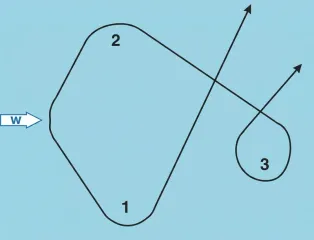
What manoeuvres did the boat perform on the plotted course at points 1, 2 and 3?
- A 1 tack, 2 gybe, 3 Q-turn. Correct
- B 1 Q-turn, 2 gybe, 3 tack.
- C 1 gybe, 2 tack, 3 Q-turn.
- D 1 tack, 2 Q-turn, 3 gybe.
Explanation by Boatpass
Point 1 is a tack: the bow passes through the wind.
Question 296 · Specific question Sailing
What should be done with a dinghy's centreboard and rudder when the boat is left at a buoy?
- A Raise the centreboard and rudder blade so that the boat can swing freely. Correct
- B Lower the centreboard and raise the rudder blade so that the boat can swing freely.
- C Raise the centreboard and lower the rudder blade so that the boat can swing freely.
- D Lower the centreboard and rudder blade so that the boat can swing freely.
Explanation by Boatpass
At a buoy, raise the centreboard and rudder blade.
Question 297 · Specific question Sailing
Why is an accidental gybe dangerous?
- A It can injure the crew, damage the rig, and cause the boat to capsize. Correct
- B It can cause a sudden change in which vessel must give way.
- C It can result in loss of steering control.
- D Another accidental gybe may follow if the boat does not bear away immediately.
Explanation by Boatpass
In an accidental gybe, the boom swings uncontrollably to the other side.
Question 298 · Specific question Sailing
A sailing boat is close-hauled when the windward shroud suddenly breaks. Which manoeuvre is appropriate?
- A Tack. Correct
- B Gybe.
- C Q-turn.
- D Head-to-wind stop.
Explanation by Boatpass
The broken windward shroud can no longer support the mast on the windward side.
Question 299 · Specific question Sailing
In strong winds, a sailboat sails on a close-hauled course using only the mainsail. Suddenly the forestay breaks. What should be done immediately?
- A Bear away onto a downwind course. Correct
- B Sheet in and head up.
- C Make a head-to-wind stop.
- D Gybe.
Explanation by Boatpass
The forestay supports the mast against aft loading.
Question 300 · Specific question Sailing
In strong winds, a sailboat sails on a close-hauled course using only the mainsail. Suddenly the forestay breaks. How can the broken forestay be quickly and temporarily replaced?
- A With the jib or a halyard. Correct
- B With the jib sheet or the main halyard.
- C With the bow line or the stern line.
- D With the jib sheet or a reefing line.
Explanation by Boatpass
A set or firmly tensioned jib, or a halyard, can provide temporary support.
 Boat