Question 140 · Specific question Inland
How must a sailing vessel behave on an inland waterway if it is on a collision course with a power-driven small craft?
- A It maintains course and speed. Correct
- B It changes course to starboard and reduces speed.
- C It stays on course and reduces speed.
- D It changes course to starboard and maintains speed.
Explanation by Boatpass
In the collision situation described, the power-driven small craft must give way and the sailing vessel maintains course and speed.
Question 141 · Specific question Inland
How must a vessel with a masthead light and side lights behave compared to a small vessel with side lights that is on a collision course?
- A It maintains course and speed. Correct
- B It changes course to starboard and reduces speed.
- C It stays on course and reduces speed.
- D It has to get out of the way.
Explanation by Boatpass
The question sets a vessel against a small craft, so the first one is not a small craft.
Question 142 · Specific question Inland
How must a power-driven small craft behave towards a windsurfer on a collision course?
- A It must give way. Correct
- B It maintains course and speed.
- C It stays on course and reduces speed.
- D There is no need to avoid it.
Explanation by Boatpass
A windsurf board counts as a small craft under sail.
Question 143 · Specific question Inland
Who must give way when a sailing craft with the wind from port meets, on a collision course, a sailing yacht with the wind from starboard that displays a black cone?
- A The sailing yacht with the wind from starboard, because it is treated as a power-driven small craft. Correct
- B The sailing yacht with the wind from port, because it is treated as a small craft under sail.
- C The sailing yacht with the wind from starboard, because it is treated as a small craft under sail.
- D Both sailing yachts, because one is treated as a power-driven small craft and the other has the wind from port.
Explanation by Boatpass
The black cone with its apex down shows that the sailing yacht is also using its engine.
Question 144 · Specific question Inland
What is one of the three basic give-way rules in the German Inland Waterways Regulations for small craft under sail?
- A If they have the wind on different sides, the sailing craft with the wind from port must give way to the sailing craft with the wind from starboard. Correct
- B If they have the wind on different sides, the sailing craft with the wind from starboard must give way to the sailing craft with the wind from port.
- C If they have the wind on the same side, the leeward craft must give way to the windward craft.
- D If they have the wind on the same side, both craft must give way.
Explanation by Boatpass
When two small craft under sail have the wind on different sides, the craft with the wind from port must give way to the craft with the wind from starboard.
Question 174 · Specific question Inland
How should an overtaking manoeuvre be carried out?
- A Overtake quickly. Do not obstruct the vessels involved. Pay attention to traffic conditions and possible sound signals. Keep enough distance. Correct
- B Overtake quickly. If necessary, accelerate the vessel quickly in order to be able to pass quickly.
- C Overtake quickly; Overtaking is only permitted on the starboard side, keep enough distance.
- D Overtake quickly. Steer close to the bank; small vessels must pay attention to any sound signals.
Explanation by Boatpass
An overtaking manoeuvre must be carried out briskly and decisively.
Question 175 · Specific question Inland
When is there a risk of a collision?
- A When two vessels approach each other on a constant bearing. Correct
- B When two vessels approach each other without changing their courses.
- C When two vessels approach each other and one vessel changes course.
- D When two vessels approach each other and both alter course to starboard.
Explanation by Boatpass
A risk of collision exists when two vessels approach each other on a constant bearing.
Question 176 · Specific question Inland
How must a manoeuvre to avoid collision be carried out?
- A In good time, readily apparent to others, and decisively. Correct
- B In good time, readily apparent to others, and to starboard.
- C In good time, readily apparent to others, and to port.
- D In good time, readily apparent to others, and cautiously.
Explanation by Boatpass
An avoiding manoeuvre must be initiated early enough to leave sufficient room and time.
Question 177 · Specific question Inland
A small vessel and a vessel over 20 m long approach each other on crossing courses. There is a risk of a collision. Who is required to give way?
- A The small vessel must give way. Correct
- B Vessels over 20 m long must give way.
- C The vessel that sees the other on its starboard side must give way.
- D The vessel that sees the other on its port side must give way.
Explanation by Boatpass
A vessel more than 20 metres long is not a small craft.
Question 179 · Specific question Inland
How must a small craft under sail beating to windward behave towards another small craft near a bank?
- A It must not force another small craft keeping to the bank on its starboard side to give way. Correct
- B It must not force another small craft leaving the bank on its starboard side to give way.
- C It may force another small craft leaving the bank on its port side to give way.
- D It may force another small craft keeping to the bank on its starboard side to give way.
Explanation by Boatpass
A small craft under sail beating to windward must not force another small craft to give way when that craft is keeping to the bank on its starboard side (§ 6.02a BinSchStrO).
Question 180 · Specific question Inland
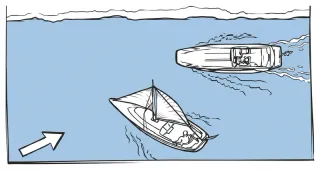
Which vessel must give way, and which vessel does not have to give way?
- A The vessel under sail must give way. Correct
- B The vessel under sail does not have to give way.
- C The power-driven vessel must give way.
- D Both vessels must give way.
Explanation by Boatpass
Both boats are small craft. What matters here is the bank: the motorboat is keeping to the bank on its starboard side.
Question 181 · Specific question Inland
What does the skipper of a small craft have to consider when encountering vessels that are not small craft?
- A Small craft must give way to vessels that are not small craft and leave the room needed for their course and manoeuvring. Correct
- B Small craft are not required to give way to vessels that are not small craft.
- C Small craft have equal status with vessels that are not small craft when meeting.
- D Small craft must give way to vessels that are not small craft, but do not have to leave them any special room for manoeuvring.
Explanation by Boatpass
Small craft must leave vessels that are legally not classed as small craft the room needed for their course and manoeuvring. “Not a small craft” includes not only vessels of 20 metres or …
Question 182 · Specific question Inland
Approaching from the port side, a sailing vessel displaying a black cone with its point downward crosses the course of a power-driven vessel. Which vessel must give way?
- A The vessel under sail with a black cone must give way. Correct
- B The vessel without sails must give way.
- C The vessel under sail with a black cone does not have to give way.
- D Both vessels must give way.
Explanation by Boatpass
The black cone shows that the sailing vessel is also using its propulsion machinery to make way and is therefore treated as a power-driven vessel.
Question 183 · Specific question Inland
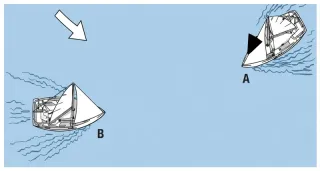
Two small craft under sail, A and B, are on a collision course; A displays a black cone. Which craft must give way?
- A Vessel A has to give way. Correct
- B Vessel B has to give way.
- C The vessel that sees the other on its port side must give way.
- D The vessel that has the wind from the port side must give way.
Explanation by Boatpass
Small craft A displays the black cone with its apex down, showing that it is also using its engine.
Question 184 · Specific question Inland
A sailing vessel is crossing an inland waterway. In the middle of the fairway, a power-driven small craft proceeding upstream comes towards it. Which vessel must give way?
- A The power-driven small craft. Correct
- B The vessel proceeding downstream.
- C The sailing vessel.
- D Both vessels.
Explanation by Boatpass
The approaching power-driven small craft must give way.
Question 185 · Specific question Inland
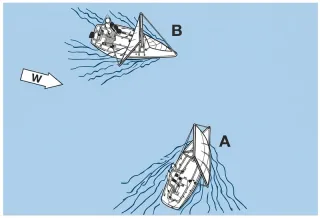
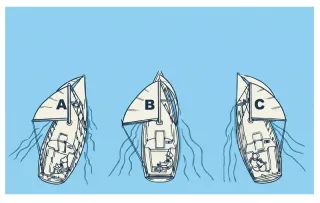
Two small vessels A and B under sail are on a collision course (sketch). Who is required to give way?
- A A must give way. Sailing craft with the wind from port must give way to sailing craft with the wind from starboard. Correct
- B B must give way. Sailing craft with the wind from port must give way to sailing craft with the wind from starboard.
- C A must give way. Sailing craft with the wind from starboard must give way to sailing craft with the wind from port.
- D B must give way. Sailing craft with the wind from starboard must give way to sailing craft with the wind from port.
Explanation by Boatpass
A has the wind from port and B has the wind from starboard.
Question 186 · Specific question Inland
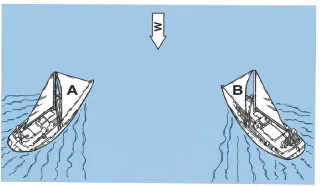
Two small vessels under sail are on a collision course. Who is required to give way?
- A B must give way. The windward boat must give way to the leeward boat. Correct
- B A must give way. The windward boat must give way to the leeward boat.
- C A must give way. The leeward boat must give way to the windward boat.
- D B must give way. The leeward boat must give way to the windward boat.
Explanation by Boatpass
Both sailing small craft have the wind on the same side.
Question 187 · Specific question Inland
Small craft A is sailing downstream at night on a run, with its mainsail to starboard. Broad on the port beam, the green sidelight of boat B, which shows no masthead light, is drawing steadily closer. Which craft must give way?
- A Small craft A must give way. A craft with the wind from port must give way if it cannot determine with certainty whether the windward craft has the wind from port or starboard. Correct
- B The small vessel A has to give way. A boat with a starboard tack must give way if it cannot clearly determine whether the windward boat has a port tack.
- C Boat B has to give way because vessel A is a small vessel under sail with the wind on the port side.
- D Boat B has to give way because it is a small vessel and small vessels have to avoid other small vessels under sail.
Explanation by Boatpass
A is running with the mainsail to starboard and therefore has the wind from port.
Question 188 · Specific question Inland
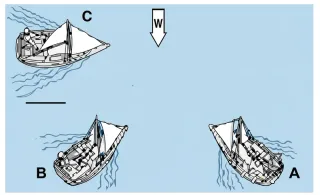
The lateral distance between boats A, B and C is constantly decreasing. Which boat can stay on course?
- A Boat A, because it is to leeward. Correct
- B Boat A, because on the windward side.
- C Boat B, because on the leeward side.
- D Boat C, because on the leeward side.
Explanation by Boatpass
C has its mainsail to starboard and therefore the wind from port, so C must give way to A and B, which both have the wind from starboard.
Question 189 · Specific question Inland
Which vessel must maintain course in relation to which other vessel?
- A A in relation to B and C; B in relation to C. Correct
- B C in relation to A and B; B in relation to A.
- C B in relation to C and A; A in relation to C.
- D A in relation to B and C; C in relation to B.
Explanation by Boatpass
In the situation shown, A must maintain course in relation to B and C, and B must maintain course in relation to C.
Question 190 · Specific question Inland
What should you pay attention to if a dinghy has capsized and cannot be righted?
- A Check that all crew members are accounted for and provide assistance if necessary. Hold on to the boat or, if necessary, lie on it and wait for help. Correct
- B Immediately give the required distress signals and use every available means to move the craft out of the navigable channel.
- C Climb onto the capsized boat and remain still to minimise heat loss. If this is not possible, swim to the nearby shore and get help.
- D Put on lifejackets and summon help by suitable means. Lower the sails if necessary.
Explanation by Boatpass
If a dinghy capsizes and cannot be righted, first check that all crew members are present.
Question 191 · Specific question Inland
A sailing boat enters the field of a sailing regatta without being a participant. Which give-way rules apply?
- A Those of the Inland Waterways Regulations. Correct
- B Those of the sailing competition regulations.
- C In relation to regatta participants, the racing rules apply, and in relation to other vessels, the inland waterway regulations apply.
- D Vessels taking part in a regatta must avoid uninvolved vessels.
Explanation by Boatpass
A sailing boat that is not taking part in the regatta follows the German Inland Waterways Regulations (BinSchStrO) for its give-way behaviour.
Question 192 · Specific question Inland
A small craft under sail is crossing the fairway at night. Off its port side, the lights shown below appear on a vessel crossing its course at an acute angle. What do these lights mean?
- A Power-driven small craft. Correct
- B Ferry-boat moving independently.
- C Pushed convoy seen from ahead.
- D Small craft being towed.
Explanation by Boatpass
The white light is at the same height as the green sidelight but some way ahead of it.
Question 193 · Specific question Inland
A small craft under sail is crossing the fairway at night. Off its port side, the lights shown below appear on a vessel crossing its course at an acute angle. Which craft must give way?
- A Power-driven small craft. Correct
- B Small craft under sail.
- C The small craft that has the other craft on its port side.
- D Both craft must give way.
Explanation by Boatpass
The vessel is a power-driven small craft. In the collision situation described, it must give way to the crossing small craft under sail.
Question 194 · Specific question Inland
A small craft under sail and using its engine is tacking upstream at night. A vessel approaches showing only a white light. What does this light mean?
- A Small craft without mechanical propulsion. Correct
- B Power-driven small craft.
- C Small craft under sail.
- D Small craft proceeding under sail and using mechanical propulsion.
Explanation by Boatpass
The approaching vessel shows only a single white all-round light as it comes near.
Question 195 · Specific question Inland
A small craft under sail is crossing the fairway at night. A vessel approaches from astern showing a two-colour lantern and a masthead light. What do these lights mean?
- A Power-driven small craft. Correct
- B Small craft without mechanical propulsion.
- C Small craft under sail.
- D Small craft proceeding under sail and using mechanical propulsion.
Explanation by Boatpass
A two-colour lantern combining the red and green sidelights together with a white masthead light identifies a power-driven small craft.
Question 197 · Specific question Inland
Where must speed be reduced to avoid suction and wash?
- A At harbour entrances; at loading, unloading and berthing places; near ferry-boats not moving independently; on marked stretches; and near floating equipment at work. Correct
- B At junctions; at loading, unloading and berthing places; near ferry-boats not moving independently; on marked stretches; and near floating equipment at work.
- C At harbour entrances; at loading, unloading and berthing places; near ferry-boats moving independently; on marked stretches; and near floating equipment at work.
- D At harbour entrances; at loading, unloading and berthing places; near ferry-boats not moving independently; on marked stretches; and near floating navigation marks.
Explanation by Boatpass
At certain locations speed must be reduced to avoid suction and wash: at harbour entrances; at loading, unloading and berthing places; near ferry-boats not moving independently; on …
 Boat